
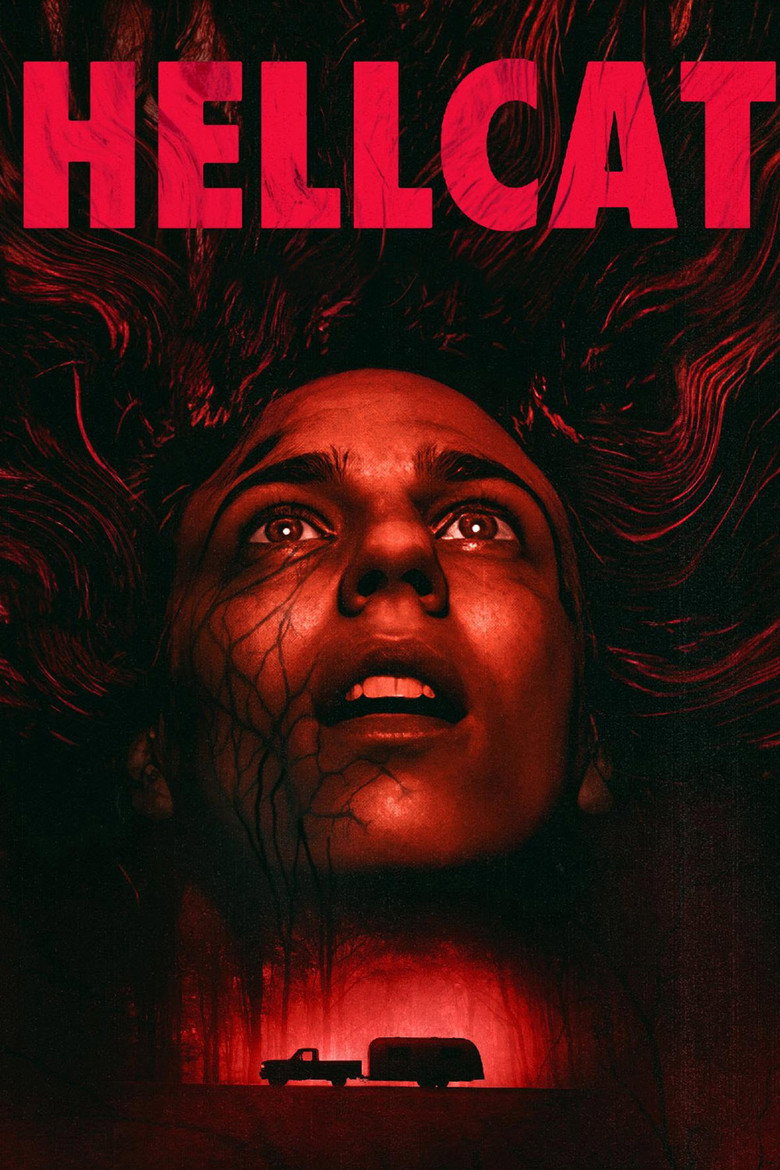
Director: Brock Bodell Screenplay: Brock Bodell Cast: Dakota Gorman, Todd Terry, James Austin Johnson, Liz Atwater, Jordan Mullins Year: 2026
Contained-space horror lives or dies on a single decision: how much you tell the viewer, and when. Too much and the claustrophobia turns into waiting. Too little and the viewer checks out. I came to "Hellcat" straight off "Iron Lung", feeling it was far too soon for another film about a few people shut inside somewhere small. I also came in knowing nothing about the plot and with expectations on the floor. I was wrong, and being wrong is probably the best recommendation I can give it.
In "Hellcat" we follow Lena Orchard (Dakota Gorman), a young woman who wakes in the back of a moving camper with no memory of how she got there. There's a wound on one arm and something that looks like an infection climbing her veins. From the cab, Clive Peters (Todd Terry) tells her they don't have long before it spreads through her whole body, and that he's taking her to someone who can treat it. He knows exactly what she has. She doesn't. And as the camper keeps moving, Lena starts going through the interior and finding things that don't square with the story that this is a rescue.
What makes the film work is a discipline productions this size rarely hold: the viewer gets not one fact more than Clive hands Lena. When she wakes without knowing why she's there, neither do you. When she looks at her arm and sees the infection moving, she knows something is on her but not what it is or what it will do, and you are in exactly that position. She doesn't know Clive or what he wants, and the script refuses to get ahead of her on him. Brock Bodell writes and directs, and tying the viewer's information to the protagonist's is what turns a drive down a road into something genuinely tense.
In this sub-genre the lead carries everything, because she has to sustain the credibility of the situation and deliver the information the confinement won't let the film show any other way, through dialogue, gesture or reaction. Dakota Gorman isn't giving the best performance you'll see this year, but the work is solid and, more to the point, believable in the stretches where the film rests entirely on her face. Todd Terry works from voice alone for much of the runtime, which is a different job and not a smaller one. For the resources involved, this is very well made.
Where "Hellcat" cracks is after its turn. There's a revelation that reorganises everything you thought you were watching, and it caught me off guard; I spent a good while afterwards mentally auditing what evidence there had been, which is precisely the reaction a film like this wants. The problem is that from that point the script starts making mistakes it hadn't made in the previous 91 minutes. The camper stretch, where Lena knows nothing, has a command of tension and of the viewer's perception that the final section loses. Once everything is explained, the film takes routes that feel less considered, and the close insists on underlining something already clear. That underlining pushes it toward the absurd and even the funny, and this is not a film that was going for laughs.
Anyone who enjoys closed-space horror in the line of "Cube" or "Crawl", where the threat matters less than the geography and the not-knowing, will find a modest but very competent entry here. Anyone who needs a film to hold its level to the last shot will hit a third act that slackens. And one thing worth saying plainly: the turn divides. If it lands for you, the rest of the film is a pleasure; if it doesn't, you'll likely feel the deal changed on you halfway. It held me for almost all of it, and for what it cost to make, that counts.
Rating: 7/10
Ending Explained (Spoilers ahead)
What Lena has isn't an infection. It's lycanthropy in progress. The wound on her arm and the thing climbing her veins are the transformation, which is why Clive knows what's happening to her without needing to examine her.
Working through the camper, Lena finds the piece that reorders everything: there's another young woman in there, Ollie (Liz Atwater), Clive's daughter and in the same condition. Clive isn't an abductor who invented a medical excuse. He's a father who has been dealing with this at home for some time and is looking for someone who can help them both. The turn works because it reinterprets the confinement rather than contradicting it: everything that looked suspicious had another explanation, set in front of the viewer without being pointed at.
Where Clive got the idea is what the film saves for last. He heard it on a late-night radio show about occult subjects, called in and spoke to the host, Jasper Deville (James Austin Johnson), and that call is where the doctor he claims to be driving them to came from. That doctor doesn't exist. It was overnight-radio material, and Clive drove hundreds of miles chasing something invented.
Deville wasn't the only one listening. Officer Crump (Jordan Mullins) was too, he's near the route, he recognises the camper, and he comes after them to kill Lena because he knows what she is. How he knows, and why this isn't late-night nonsense to him, is never explained. I suspect that's deliberate, since we follow everything from Lena's vantage and she doesn't understand where this man came from either, but the device still feels thin.
Lena survives the confrontation. Clive doesn't. That's where the detail the film dropped early pays off: Lena said she was pregnant even though she didn't look it, because she was very early on. The pregnancy is real, and the lycanthropy accelerates the gestation, so she gives birth shortly after Crump. The baby is a wolf, and it looks bad. It reads as a toy, and it's the weakest thing on screen.
Lena leaves with Ollie and her son, and there the film ends. The close confirms this was never delusion or infection: they are what Clive said they were, and the birth underlines it. The film's best version was the journey, not the destination.
No comments:
Post a Comment