
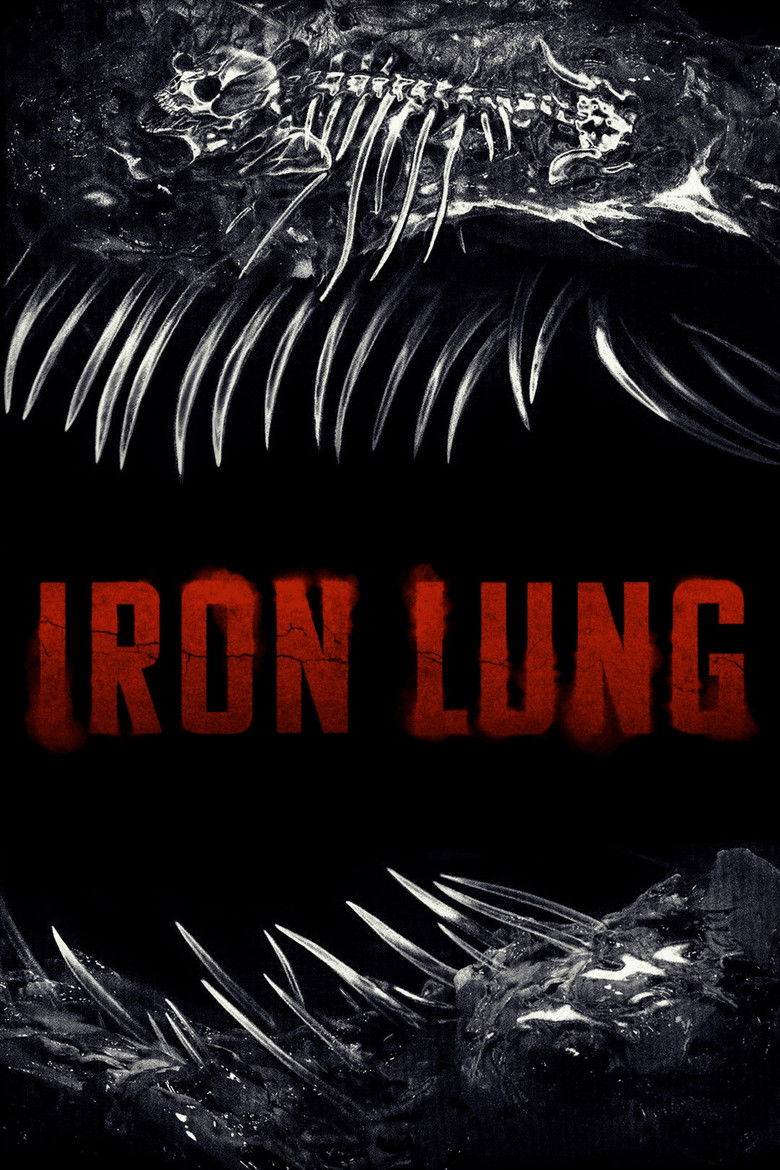
Director: Mark Fischbach Screenplay: Mark Fischbach Cast: Mark Fischbach, Caroline Kaplan, Troy Baker Year: 2026
Horror games have spent years producing material that film has failed to capitalize on, and the adaptations that do reach the screen usually betray the exact thing that made the game work. "Iron Lung" starts from an unusual position: David Szymanski's game is a minimalist cult object among people who play horror, and the person bringing it to the screen is Mark Fischbach, better known as Markiplier, who built an enormous audience doing precisely that. He directs, writes and stars. The result is a film that lands the atmosphere and stumbles exactly where you fear a debut of this profile will stumble.
In "Iron Lung" we follow Simon (Mark Fischbach), a convict in a post-apocalyptic world following an event known as the Quiet Rapture, after which humanity survives in a form nothing like the one we knew. Simon belongs to EDEN, the faction holding that humanity is already finished, set against the group that still believes a second chance exists. Convicted for taking part in an attack on a facility, his punishment is a mission: they put him in a submarine and send him to explore an ocean of blood on a desolate moon, with instructions to take photographs and gather information about whatever is down there. Nobody explains clearly what they are looking for, but the insistence on the exploration makes it obvious that somebody already knows something is there.
The sub-genre is one-man claustrophobic horror, the branch running from "Das Boot" (1981) into the more cosmic territory of "Event Horizon" (1997) and "Sphere" (1998), and whose best recent aquatic entry was "Underwater" (2020). "Iron Lung" stays inside the submarine for nearly its entire runtime. There are other characters, but we never see them: they exist purely as voices, among them Troy Baker, who lends the film the same vocal craft that carries half the last decade of video games. That restriction is the film's best decision and it is faithful to the game: one man, one cabin, a set of instruments, and outside a liquid that shows you nothing.
Where the film clearly works is atmosphere and sound. Fischbach understands that the terror here is not in what gets shown but in the mechanism of showing it. Simon has a viewport, and it is useless to him: submerged in blood and total darkness, the glass shows nothing at all. His only way of knowing what is out there is an x-ray camera he scans his surroundings with, then reads back whatever the shot returned. When a creature starts appearing in those images, the film reaches its best tension while showing almost nothing, and that scanning device is the smartest thing it does. The sound design pushes the same way, with the hull, the pressure and noises that never quite resolve building a permanent sense that something else is happening out there. The creature is never fully defined, but it becomes clear it has some capacity to get inside people's heads.
Where "Iron Lung" fails is pacing and the lead performance. The film runs 125 minutes and nearly everything that happens reaches us through dialogue, which is a heavy load for a runtime that long. The opening moves well because it is establishing the world, the factions and the mission, but after that block the pace drops considerably and stays down until the last act tightens things again. There is a version of this film twenty minutes shorter, or the same length but far denser, that would be plainly better. And on Fischbach as an actor I cannot be as generous: he is not bad, but in several stretches he overplays, pushing reactions the material wanted held back, and in a film resting entirely on one face that costs.
The other problem is the redemption arc the screenplay builds for Simon. The film spends much of its runtime establishing him as a man defined by an act of destruction and by his commitment to the faction that has written humanity off, and then lands him on a gesture of generosity that never quite connects to any of it. It took me out of the film. It is possible this is personal taste and that I was asking for something deeper than the film set out to deliver, but the turn feels imposed rather than earned.
Viewers who enjoy atmospheric horror in confined spaces, suspense built out of sound, and those who already know Szymanski's game and want to see how far the translation goes will find an entertaining film here that is honest about its source. Anyone who needs firm pacing, solid performances and a character arc that closes properly will hit all three fronts where the film gives way. I liked it and it kept me entertained, but it stops halfway to what its premise allowed.
Rating: 6/10
Ending Explained (Spoilers ahead)
The film never delivers the complete explanation its first act promises, and that is a structural decision rather than an oversight. What holds to the end is ambiguity about two things: what exactly the creature is, and what they were really looking for in that ocean.
On the creature, the film is careful not to define it. We never see it with the clarity monster movies usually demand; it reaches us the same way it reaches Simon, in photographic fragments, appearing in shots where nothing should be. What does get established is that it has some form of access to the human mind, which turns everything Simon perceives into suspect material. That is the real mechanism of the horror here: in a film where the protagonist is the only source of information, a creature that manipulates perception makes the entire account unreliable.
On the mission, the film makes clear that the faction sending him knows more than it says. The emphasis on exploring, photographing and recording the floor of that ocean, and the repeated line that what humanity needs for its future is down there, point to somebody having identified something before Simon was ever dispatched. What Simon finds for most of the journey is a relatively normal ocean floor, and that normality is part of the deception.
The closing bets on Simon's redemption arc: the man convicted of an act of destruction, a militant of the faction that declared humanity over, ends up choosing something less selfish than his history would lead you to expect. Thematically the gesture closes the opposition between the two factions, EDEN and those who believe in a second chance, resolving it inside a single character. The problem is that the film did not build enough for that turn to feel earned, and the ending ends up explaining a thesis the film had not actually done the work on.
No comments:
Post a Comment