
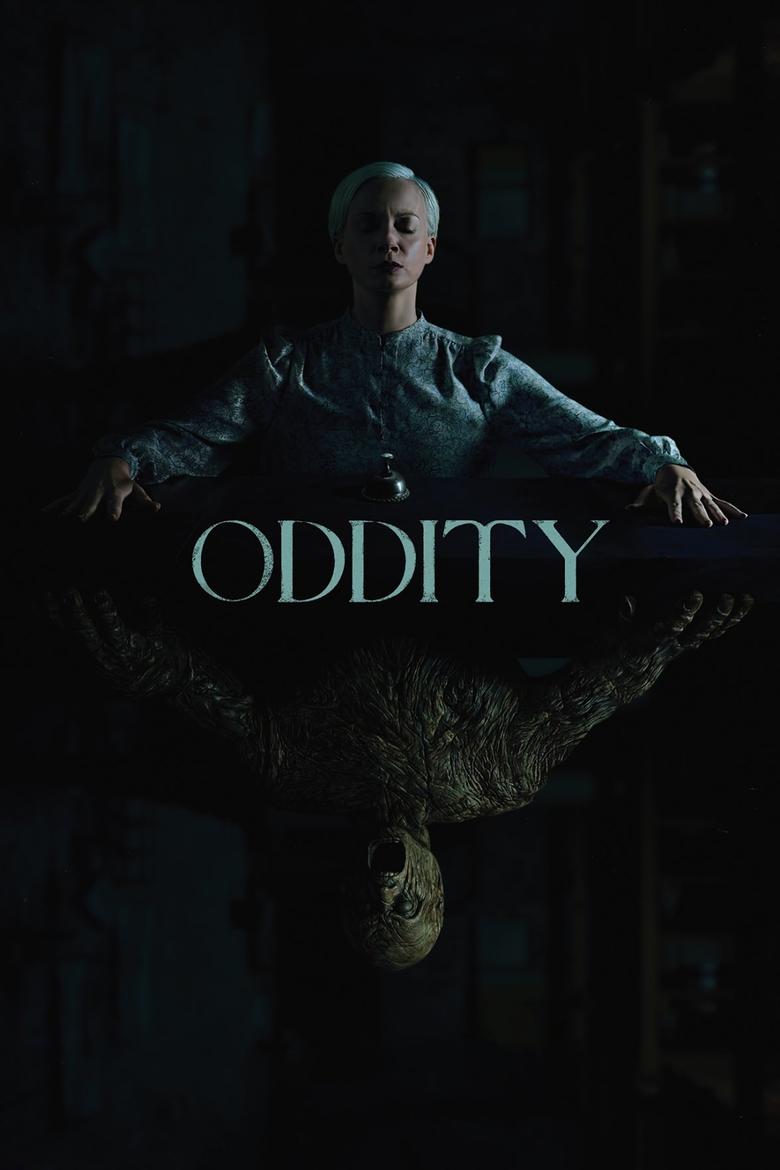
Director: Damian McCarthy Screenplay: Damian McCarthy Cast: Carolyn Bracken, Gwilym Lee, Caroline Menton, Steve Wall, Tadhg Murphy Year: 2024
Damian McCarthy is one of those directors you could see coming. In 2021 he released "Caveat," a low-budget debut with a disproportionate ambition that already showed an unusual command of suspense and of the geography of domestic horror. Three years later comes "Oddity," his second feature, with Shudder behind it and with the kind of expectations that tend to crush a filmmaker when their first work sparked too much interest. The short answer is that McCarthy survives the jump: "Oddity" has the same ingredients that made "Caveat" work (atmosphere, a house that breathes, visual precision) but it also carries a structural problem that keeps it from reaching the level the expectations were promising.
In "Oddity" we follow Darcy (Carolyn Bracken, in a dual role that also plays her twin sister Dani), a blind woman who runs a shop of artifacts and has a peculiar gift: touching certain objects lets her perceive events tied to them. Her sister Dani has died in her new rural house, a half-remodeled Irish stone home, under circumstances officially attributed to a recently-discharged psychiatric patient from the hospital where Dani's husband, Ted (Gwilym Lee), works. A year later, Darcy still isn't buying the official story of what happened to her sister, and starts looking into it on her own.
The first thing to acknowledge about "Oddity" is its command of place. The stone house where almost all the runtime happens becomes the film's other protagonist. McCarthy frames the corridors, the corners, and the staircases with a patience that makes each shot carry the sense that something could happen at any moment, and several times it does, with jumpscares that are planted with intelligence and don't function as empty shocks but as part of the narrative advance. It's the same instinct McCarthy displayed in "Caveat" with that room and the drum-doll, now applied to a bigger space with more corners to hide threats in.
Carolyn Bracken carries the film in a dual role that demands more than it first appears. Darcy (the blind sister, the survivor, the investigator) carries almost all the present-tense runtime, while Dani appears in flashbacks and in the visions Darcy has when touching objects. Bracken differentiates the two sisters with very small nuances (posture, gaze (or its absence), the way she inhabits space) without relying on obvious cosmetic changes. It's one of those performances that sustain a film without calling attention to themselves.
The sub-genre "Oddity" fits into most comfortably is the "haunted object" tradition: the long line that runs from the "Annabelle" dolls to the Talking Tina of "The Twilight Zone," through the Zuni fetish doll of "Trilogy of Terror." The wooden mannequin Darcy brings to the house as a gift operates in that tradition, but McCarthy gives it an interesting twist: the mannequin isn't the main horror of the story but an instrument within a larger plan that the film itself dismantles. It's a decision that separates "Oddity" from most of its predecessors in the sub-genre: the haunted object isn't the enigma but the weapon.
Where "Oddity" fails to fully distinguish itself is in the plot. The central revelation of the murder, who the true culprit is and why, is telegraphed earlier than the film seems to assume. The structure of jumps between present and past, seemingly designed to disorient the viewer, doesn't quite achieve its aim: the conclusion it points to becomes visible well before the climax, and the climax itself, the confrontation in the house, is probably the film's weakest point. Everything McCarthy builds so patiently in the first two thirds resolves in a final third that feels somewhat rushed and structurally conventional. The real ending (the film's last shot, not the climax) is where McCarthy shows himself at his best again.
Fans of atmospheric horror, and anyone who enjoyed "Caveat" or any recent Irish-cinema entry from the Shudder catalog, will find in "Oddity" a worthy and visually confident entry. Those coming for a mystery that surprises them until the last minute will probably feel a step ahead of the film more often than they should. But even with that flaw, "Oddity" holds together on its craft, on Bracken, and on a closing that redeems everything that came before with very few elements.
Rating: 7/10
Ending Explained (Spoilers ahead)
The culprit of Dani's murder is Ted, her husband. He didn't kill her directly: he hired Ivan, an employee of the psychiatric hospital, to do it, and then let the blame fall on him by exploiting his history and lack of credibility. The reason Ted decides to kill Dani is revealed toward the end: a combination of infidelity and financial motives tied to his new girlfriend, Yana, who was already in the picture before the death and with whom he now openly lives in the same house. Darcy, after using the alleged killer's prosthetic eye to see the real crime scene, understands who the true perpetrator is and returns to the house with a plan.
The wooden mannequin Darcy brings as a "gift" is a cover. The confrontation ends with Darcy dead: Ted pushes her through a hole in the floor left over from the house's remodeling, and it's Ivan who then finishes her off. On the surface, everything works out for Ted: the hitman escapes, but on his way out of the house he starts talking about being attacked by a wooden mannequin, a story so absurd that Ted uses it as a pretext to have him committed to the psychiatric hospital. Nobody's going to believe a man who says a mannequin attacked him, and Ted is free of his last loose end. Everything looks closed in his favor. But then Darcy, who had anticipated this possibility, sends Ted, after her death, a box containing an artifact from her shop: a reception bell that had been described earlier in the film as haunted. Ted doesn't believe the story about the bell and rings it. At first nothing seems to happen, until the film's last shot shows him sitting in his living room, with a ghostly figure appearing behind him. The camera stays there. The story ends at that point, with no further explanation, because it doesn't need one: it's clear Ted isn't going to get the quiet ending he thought he'd bought. That decision to close with implication rather than resolution is probably "Oddity"'s best moment, and where McCarthy shows, once again, that he knows when to speak and when to stay silent.
No comments:
Post a Comment