
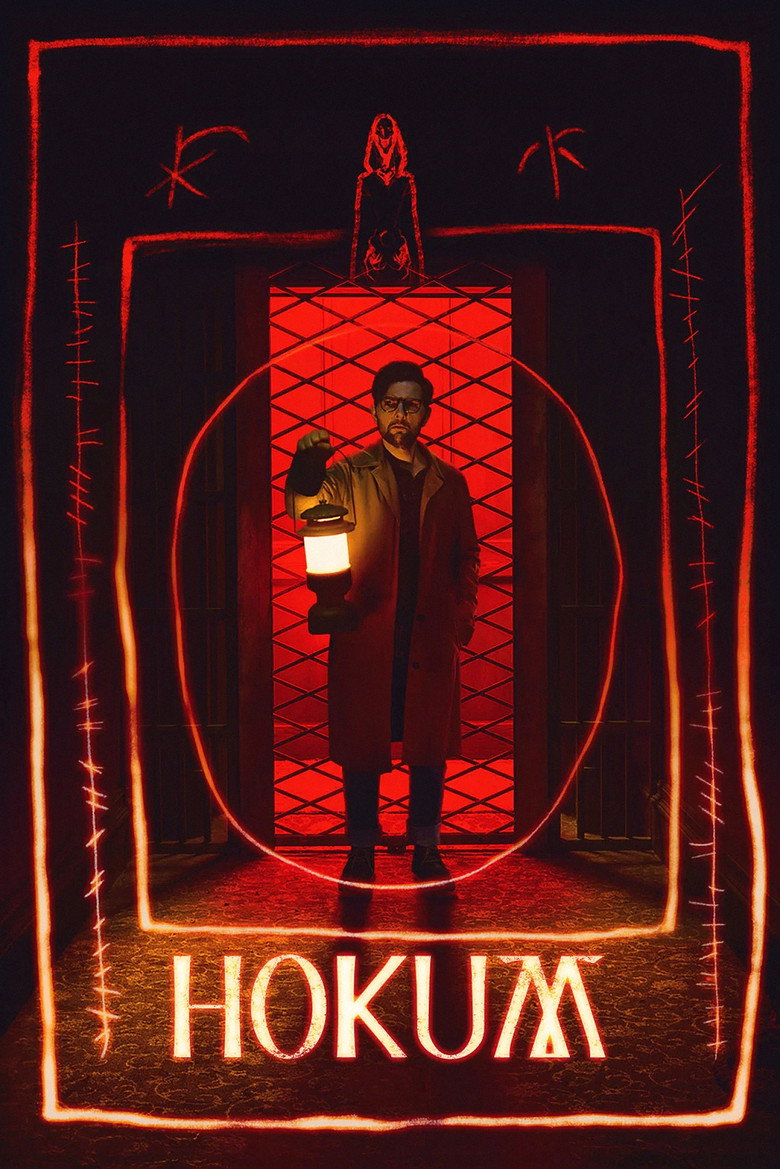
Director: Damian McCarthy Screenplay: Damian McCarthy Cast: Adam Scott, Peter Coonan, David Wilmot Year: 2026
"Hokum" is the third consecutive piece in an arc that started small and no longer allows any disguise. Damian McCarthy debuted in 2021 with "Caveat," a modest film with a command of space that announced a director. Three years later, "Oddity" confirmed that command and gave him his first major platform through Shudder. "Hokum" arrives in 2026 with the kind of expectations that tend to be dangerous for a filmmaker who has been scaling up with precision, and the short answer is that McCarthy survives the jump but not entirely intact. The film is good; it simply doesn't reach the height the hype had marked for it.
In "Hokum" we follow Bauman (Adam Scott), a successful writer who arrives at a rural Irish hotel with two objectives that, in the first half hour, seem barely connected: finishing the final book of a famous trilogy that has stalled at its ending, and scattering his parents' ashes at the place where they had spent their honeymoon. Bauman is arrogant, difficult, with a layer of contempt for almost anyone who crosses his path, and McCarthy makes no effort to soften him during the film's first act. Shortly after settling in, Bauman starts to notice that something else lives behind the hotel's walls that can't quite be seen, and that the staff would rather nobody ask about it.
The first thing McCarthy does very well in "Hokum" is the same thing he already did well in "Caveat" and "Oddity": turning domestic space into threat. The hotel is an old building with too many doors, too many stairways, and too many corners where something could be watching without you knowing, and the legends and superstitions surrounding it help amplify that presence. The jump scares are planted with craft, not as empty jolts but as part of the plot's forward motion, in the same way they operated in "Oddity." The difference is scale: where "Oddity" concentrated almost all its terror in the remodeled house, "Hokum" spreads it across a much bigger building, and that spread works partly against the film in the first half. It takes a while to start.
The construction of the protagonist is probably the most interesting thing in the film. Bauman is a character you don't want to spend two hours with; he's unlikeable from his first appearance and the film does nothing to soften that. And yet two decisions gradually rescue him. The first is that Bauman, even inside his arrogance, intervenes in situations of injustice when he encounters them, a small gesture that doesn't offset the rest of his behavior but begins to suggest there's something else underneath. The second is that you sense early on that his antipathy is a response to something specific, not a gratuitous trait, and the film accumulates that intuition until it pays it off in the final third. Scott sustains that doubleness with precision: the contempt works on the surface while something else leaks in through the edges.
The sub-genre "Hokum" fits into is the haunted-hotel tradition with Irish folk horror as background respiration, a lineage that runs from "The Shining" through more recent works like "The Innkeepers," but here crosses with the religious and superstitious weight of European folk horror. McCarthy doesn't hide the references, such as the sealed bridal suite, the witch of local rumor, and the building as an archive of other people's guilt, but combines them in a way that feels his own. As in "Oddity," the supernatural object ends up being an instrument within a wider moral structure, not an end in itself. The witch isn't the mystery of "Hokum"; she's its balancing mechanism.
Where the film loses points is in two structural decisions. The first is pacing: the introduction of characters and situations feels somewhat disorganized in the first half, with too much information that doesn't find its place until the plot kicks in. The second is more serious and happens in the final act. The film had closed its protagonist's redemption arc with the necessary weight, and then adds a final scene that tries to open the possibility that everything might have been a hallucination. The problem is that the film itself leaves physical evidence to the contrary on the protagonist's body, and that contradiction doesn't read as deliberate ambiguity but as the need to leave a door open that "Hokum" didn't need. It's the kind of gesture that takes more from the ending than it adds.
Fans of atmospheric horror and anyone who has followed McCarthy since "Caveat" and "Oddity" will find in "Hokum" a more ambitious but also more uneven entry. Those coming in expecting the geometric precision of "Oddity" may leave with the feeling that McCarthy scaled his ambition faster than his capacity to contain it. And those arriving without knowing the director will see a solid horror film with excellent acting work and a background theme, guilt as currency, that holds up on its own.
Rating: 7/10
Ending Explained (Spoilers ahead)
The moral axis of "Hokum" is guilt, and McCarthy distributes it across three characters who carry it in different ways. The first is Jerry, a local, who years earlier killed his wife when she was terminally ill and suffering. It was an act of compassion, and Jerry has even had a later vision in which his wife thanks him for freeing her from her pain, but he still carries that death as active guilt. The second is Bauman. When the film starts, we don't know why he is as unpleasant as he is; the final third reveals it: as a child, he took his father's gun and accidentally shot his mother, killing her. His entire adult personality has been built on top of that never-processed guilt. That's why the ritual gesture with the ashes reads so differently depending on whose ashes they are: his mother's he scatters with care, with love, in the place where she had been happy; his father's he throws with disdain. The third is Mel, a hotel employee, and the only one of the three with no attenuating circumstances: he killed Fiona, a coworker with whom he had been in a relationship, because she had gotten pregnant and he was married. He hid her body in the sealed bridal suite and never showed remorse for his actions, only fear that the truth would come out.
The hotel's witch is real and works as a balancing system. She stalks Bauman until he manages to forgive himself for his mother's death. She takes Mel with no possible negotiation, because his guilt has no compassion and no accident behind it. Jerry, whose guilt was technically unjustified, dies in the process at Mel's hands while trying to help Bauman find Fiona. The revelation that Fiona was in the bridal suite, murdered by Mel, is the payoff of the mystery track; the payoff of Bauman's arc is his capacity to reach self-forgiveness for a fatal, but entirely accidental, action.
The only element of the closing that betrays that architecture is the scene suggesting Bauman ingested a drug at some point during his stay and that the whole experience with the witch could have been induced. The film leaves physical evidence on his body, the marks of the witch's chains, that discard that reading, and that's why the final ambiguity fails to settle: the facts have already refuted it. McCarthy probably wanted to leave a door open to the viewer's skepticism, but the door had already been nailed shut by what the film itself had shown.
No comments:
Post a Comment