
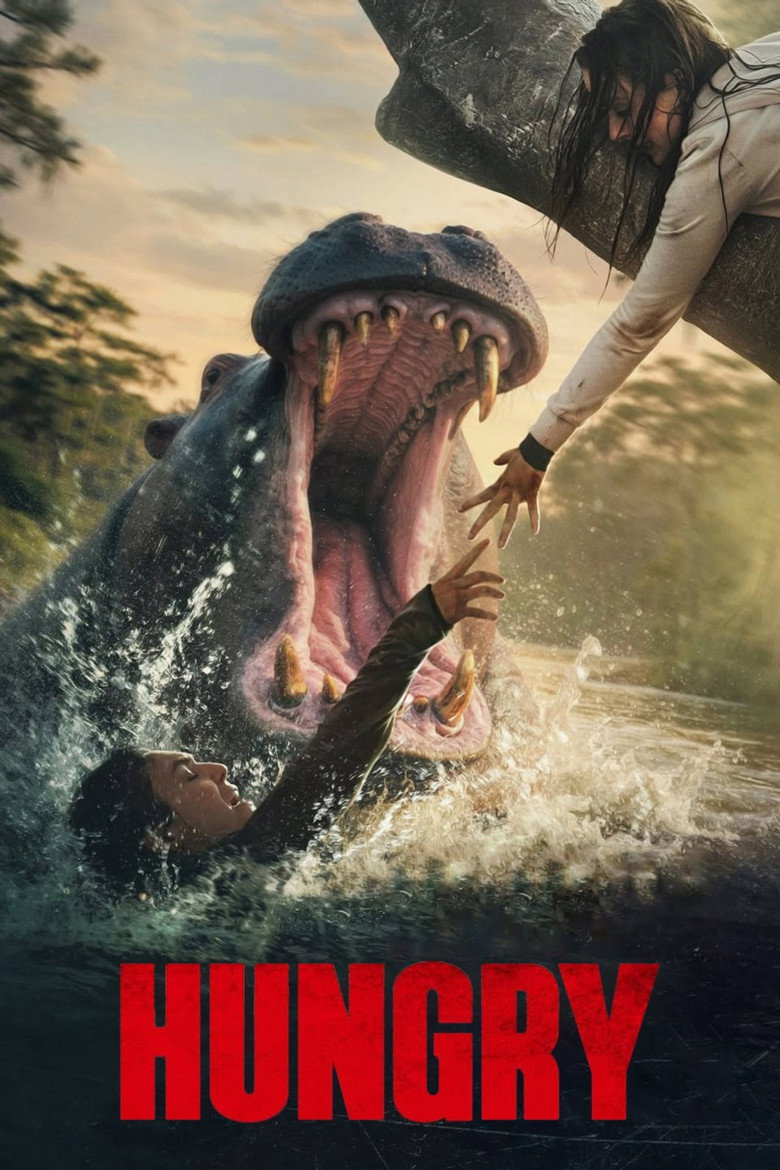
Director: James Nunn Screenplay: James Nunn Cast: Madison Davenport, Tracey Bonner, Joaquim de Almeida, Michel Curiel, Samantha Coughlan Year: 2026
Every summer brings its quota of creature features, and the threat is almost always a shark. Now and then an alligator turns up, or some other beast, but I can't recall a film where the danger was a hippopotamus, which is odd, because in reality these animals kill far more people per year than sharks, whose numbers are quite low, and more than crocodiles and alligators do. The premise of "Hungry" caught my attention for exactly that reason: it brings a new creature to the screen, and one that genuinely is a threat in parts of the world. The problem is that having the best premise of the summer counts for nothing if the film doesn't know what to do with it.
In "Hungry" we follow a group who book a boat tour through a Louisiana swamp to see alligators. Partway through, the guide leaves the route to reach a GPS-tagged specimen, supposedly the largest they've seen, and the detour puts them in hippo territory. These animals are extremely territorial, so the mere presence of the boat already constitutes a threat, and the hippo sets about defending its space. The group ends up trapped in a stretch of swamp with no way out, with the added problem that nobody is looking for them: the detour wasn't part of the tour, and it happened because someone paid for it off the books.
The script is the central problem. The film establishes early that the detour happened because somebody paid for it, and that fact should ignite a human conflict inside the group: someone is responsible for all of them being where they are. Instead the matter is handled with an indifference that doesn't survive common sense, because a group of people in that situation would not let something like that slide. The script insists on building a human antagonist while refusing to charge him for anything, and that contradiction never resolves. It's a bet with no return: the film spends runtime on a character it has no intention of using dramatically, and every scene it gives him is time taken from the animal.
Technically there's a striking contradiction. The hippo's early appearances are CGI and the director tries to hide them, with good reason, because they look poor. Later we see the animal whole and in full light, and in those scenes it looks excellent. I suspect practical effects are involved, because the gap is too wide to be the same method, and when the hippo is well realised the film finally finds some weight. What's baffling is how little of that there is.
Which brings us to the cardinal sin for a creature feature: the hippo is barely present. The overwhelming majority of the runtime goes to the characters, and most of the deaths happen off camera. In this sub-genre what matters most is how threatening the creature is, and that is measured in the damage you watch it do. Here you don't watch it, so the animal ends up looking less dangerous than both reality and the film's own premise promised. Worth noting that this is a PG-13 film, which is already a warning: in a creature feature that rating forecasts little gore and little creature on screen, and "Hungry" honours that forecast to the letter. Compared with "Crawl", which in an equally confined space understood that you have to show the animal doing harm, the difference in craft is obvious. At least it never sinks to the level of "Chum", which demonstrated earlier this year just how low the genre can go.
The title deserves its own paragraph, because it's a commercial lie. "Hungry" tells the viewer the creature wants to eat the survivors, when the film quickly establishes that the animal is defending its territory and explicitly rejects the idea that hippos attack humans for food. It creates the wrong expectations on purpose, and it reads as a mediocre attempt to make the product more appealing to a horror audience than it actually is.
There are entertaining moments and the premise remains good, so anyone with a high tolerance for low-budget creature features will get through ninety-three minutes without much suffering. Anyone after a threatening creature, deaths with weight, or a script that holds together will find a thoroughly average film with large holes and half-built characters. It's a shame, because the hippo deserved its movie and this isn't it.
Rating: 4/10
Ending Explained (Spoilers ahead)
The final act leaves the survivors trapped in a small cabin with the hippo attacking the structure from outside. Mid-siege, the protagonist notices a baby hippo pinned under some materials and decides to free it. That act is what resolves the film: with the calf released, the adult animal determines she isn't a threat and stops attacking, which lets her get out alive. The survivors had already set the cabin on fire hoping someone would see the smoke, and a passing helicopter does spot her and carries out the rescue.
As a resolution it's consistent with what the film had been arguing. The hippo was never a monster: it was a territorial animal protecting its calf and its space, and the real threat was always the human decision to invade that territory for money. Defusing the conflict with an act of care rather than a weapon is, on paper, the correct conclusion for that premise.
The problem is how it feels. After spending the whole runtime building the idea of an unstoppable predator, the climax resolves because the protagonist does something kind, and that lands anticlimactic and frankly disappointing. There's no confrontation, no cost, no final demonstration of what the animal can do. And the character who caused the entire disaster dies along the way without that death meaning anything to anyone, which leaves the impression that the film wanted a human antagonist and simultaneously didn't want to deal with one.
The title's incoherence also hangs over the ending. If the thesis is that the hippo was protecting its calf, then calling the film "Hungry" was a marketing decision made against what the story itself argues.
No comments:
Post a Comment