
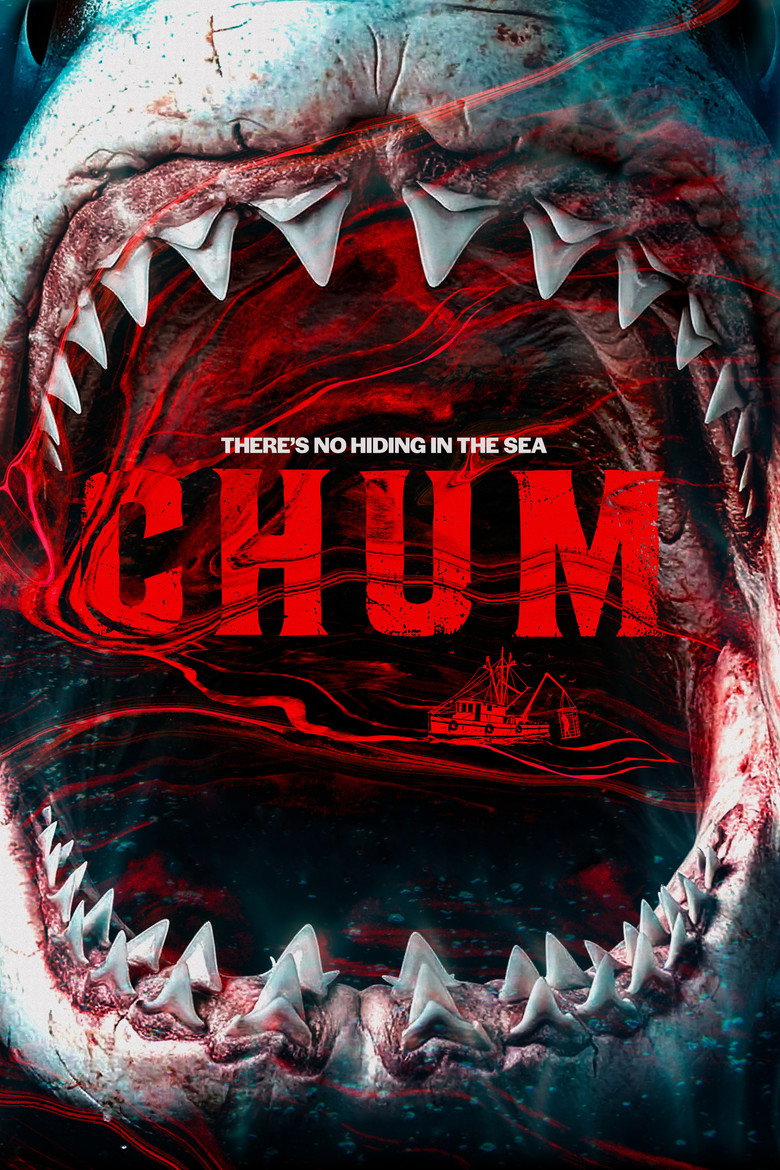
Director: Jonathan Zuck Screenplay: James Kondelik, Ryan R. Johnson, Dick Grunert, Jonathan Zuck, Joe Leone Cast: Alice Eve, Eric Michael Cole, Jim Klock Year: 2026
Every summer brings its unavoidable batch of shark movies, and every summer one or two get rescued while several are forgotten ten minutes after viewing. "Chum" belongs to the second category by such a wide margin it almost deserves its own sub-category. It's a film signed by five screenwriters, shot mostly in Malta doubling for the Mediterranean, mixing a CGI shark, a serial killer and a marital crisis in 87 minutes without making any of the three elements justify their own presence. It isn't that "Chum" has isolated flaws inside an otherwise solid body: the whole film is the flaw.
In "Chum" we follow a newlywed couple celebrating their wedding on a Mediterranean island and taking the occasion to go on a yacht excursion with friends. Before they even set sail we can tell something between the bride and groom doesn't fit, that the extravagance of the wedding contrasts with the actual state of the relationship, and that incongruence is the first of many. As soon as the yacht reaches open water a shark appears, the boat catches fire, and the group ends up in the water at the mercy of a second human presence that claims to have rescued them. From there "Chum" tries to be three films at once, and fails at all three.
The sub-genre "Chum" is trying to slot itself into is the shark creature-feature, a tradition that starts with "Jaws" (1975) and by now splits between films that understand the sea itself is the antagonist, like "Open Water" (2003) or "The Reef" (2010), and films that use the shark as an excuse to stack graphic kills. "Chum" wants to be the first but ends up being the second, without the honesty of admitting it. The shark behaves as if pre-programmed to attack humans, doing impossible things just to position itself under whoever is still alive, and the sound design matches that video-game logic: the bites sound as if the animal were eating a head of lettuce, not tearing through flesh and bone. It's a technical problem and also a problem of intention.
The script is where the film crashes loudest. Five credited writers and it feels like none of them read what the others wrote. The characters are on screen the entire time, but they exist only to deliver whichever joke the film needs; from one scene to the next they never accumulate an identity of their own or any trait to tell them apart. They're supposed to be a group of friends but each one comes from a different film, with tones and motivations that never converse. The jokes are placed in the worst possible spots and the performances can't defend them. Alice Eve, who has shown in other films that she can carry a dramatic role, gets trapped here in a text that gives her nothing and a tone that swings between horror-comedy pastiche and straight thriller. The dialogue sounds artificial in the very particular way it does when a script has passed through too many hands and none of them managed to land on coherence or even basic competence.
The environmental subplot is the most obvious symptom of that scattered writing. One member of the couple is a committed environmentalist and the other is about to accept a position at a company with a history of environmental scandals, and that tension is supposed to be the emotional engine that the survival plot has to resolve. The problem is the film gives that conflict not a single real moment. It introduces it in a couple of lines, drops it for 70 minutes, and closes it at the end with a moral decision so telegraphed and so unearned that it reads as a letter of intent glued to the back of a different film.
Technically "Chum" is also a disaster. The editing mixes traditional camera work, drone footage and stock footage with a brutality that reads not as style but as lack of options: every cut reveals a different image quality, a different lighting setup, a different color temperature, and the film makes no effort to unify them. The incidental music is mixed too loud, buries the dialogue, underlines what was already obvious and ruins the few silent beats the story needed. The CGI shark looks pixelated in several shots and outright fake in others. In an era where "The Meg" achieves convincing CGI through its budget and "The Shallows" achieves a convincing practical shark through its ingenuity, "Chum" has neither the money nor the creativity to justify its visual proposition.
It's hard to recommend "Chum" to anyone not specifically looking for a bad film to laugh at. Shark-subgenre fans have enough catalog between "Jaws", "The Reef", "The Shallows" and "47 Meters Down Uncaged" to never need to drop to this floor. Fans of conscious bad-movie viewing, of authentic bad-movie-club material, might find here material for an organized mocking night, but even that use is limited because the film never quite reaches the level of entertainment its failure would need. It's as bad as "The Requin" or "Deep Blue Nightmare", only without the low-budget excuse: here there were five writers, a recognizable name in the cast and a real Malta location, and the result is still this.
Rating: 1/10
Ending Explained (Spoilers below)
The hidden engine of the plot in "Chum" is the man who rescues the survivors after the wreck, a local Mediterranean fisherman who pretends to be in the right place by accident. In reality he has spent years hunting the shark that killed his wife in an earlier attack, and his plan when he picks up the group isn't to save them but to use them as bait, exactly as the English title announces without subtlety. The reveal of that intention lands in the middle of the film and changes nothing because the film never built the friends as characters solid enough for their status as bait to carry emotional weight; they're numbers we expect to watch die.
The resolution of the main conflict happens when the newlywed couple, after losing several friends between the shark's bites and the fisherman's manipulations, manages to neutralize the human villain and throw him into the water. The shark, which had spent the whole film chasing random humans, this time acts as a hunter with memory: it recognizes the fisherman who was hunting it and closes the crossed-vengeance loop by devouring him. The couple makes it back to shore alive and the film ends on what is supposed to be their emotional reconciliation.
The environmental coda is the final gesture. The wife, who was about to accept the position at the company with the environmental-impact record, decides not only to reject it but also to publicly expose the company's environmental abuses. It's the moral conversion the survival plot is supposed to have earned, but as noted, the environmental conflict had been treated in so few minutes and with so little depth that the decision feels imposed from outside. The reading the film proposes is that facing death returns the protagonist to her original values, but the real subtext is that the writers needed a thematic closing and picked the most obvious one available.
Nothing in the ending of "Chum" surprises. Everything the film hints at in its first act plays out in the expected order, every secondary character dies in the most predictable sequence, and the environmental message is laid out with the elegance of a placard. It's the kind of closure that confirms, rather than complicates, the overall sense of the film.
No comments:
Post a Comment