
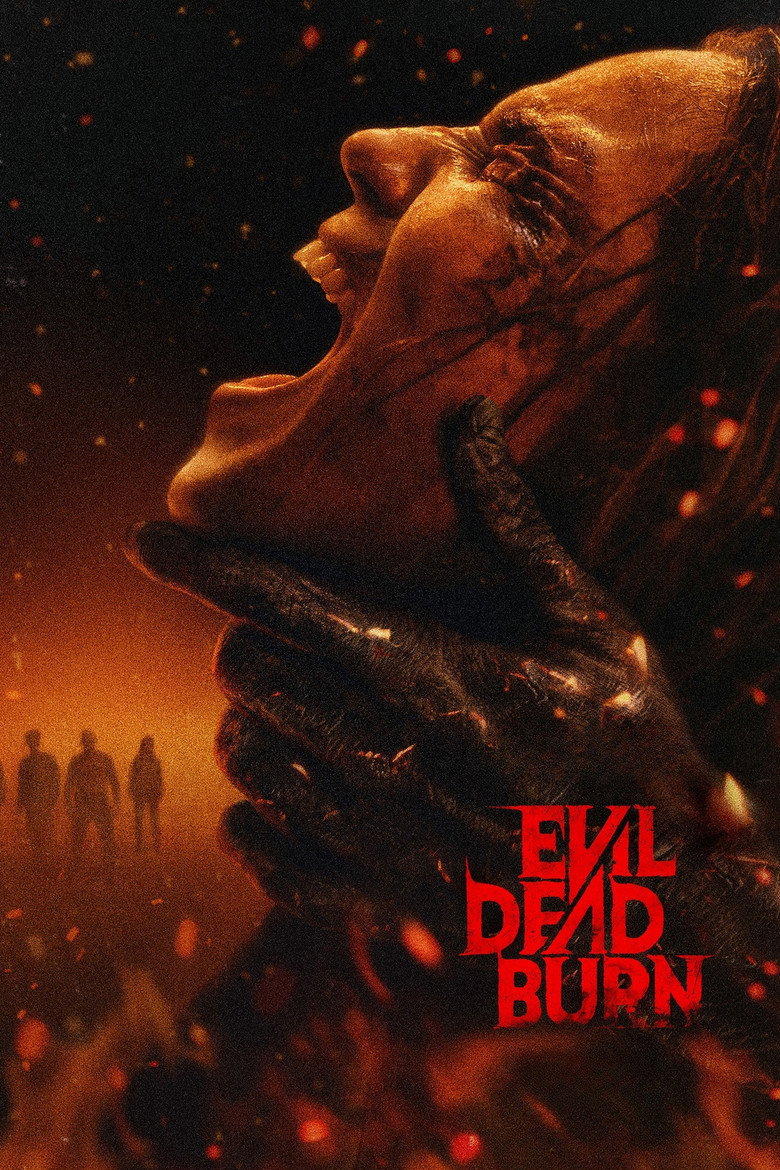
Director: Sébastien Vaniček Screenplay: Sébastien Vaniček and Florent Bernard Cast: Souheila Yacoub, Hunter Doohan, Tandi Wright, Erroll Shand Year: 2026
Few horror franchises have aged as well as Evil Dead. Sam Raimi launched the original in 1981 on a miserable budget and disproportionate ambition, then made an unexpected turn with "Evil Dead II" and "Army of Darkness" — pushing the saga toward a physical, grotesque comedy that turned it into an absolute cult object. Decades later, the 2013 remake made the opposite turn toward pure, dark, gory horror, a tone "Evil Dead Rise" confirmed in 2023 as the franchise's new editorial line. Now comes "Evil Dead Burn," directed by Sébastien Vaniček — the French filmmaker behind "Infested," personally chosen by Raimi after seeing that debut — with Raimi producing and with the responsibility of keeping one of modern horror's most beloved franchises alive.
In "Evil Dead Burn" we follow two brothers and their partners, spending a night at a club when an argument breaks out between one of them and his wife. He storms out, and on the road is intercepted by a strange woman walking in the middle of nowhere — a figure who comes, the film suggests, from events left open in the previous installment. The crash isn't an accident — the woman engineered it. Soon after, the rest of the family gathers at the parents' house to process the loss, and that's where the film unleashes its real material: a demon that filters through the family members, an ancestral object kept in the house that the grandfather had obtained to fight these entities, and the kind of escalating bloodletting the franchise has been training its audience for since the 2013 remake.
The first thing to acknowledge about "Evil Dead Burn" is its visual craft. Vaniček brings from "Infested" a preference for close-in framing that here he exploits with intelligence: the camera clings to faces, hands, objects, with an insistence that produces an almost physical discomfort. It's a very different aesthetic choice from Cronin's in "Evil Dead Rise," which operated with wider, more architectural framing; Vaniček opts for the claustrophobic, and that choice gives the film its own identity within the modern trilogy without sacrificing the features that make it recognizable. Practical effects, as is customary for the franchise since 2013, are excellent — there are images that hurt to watch, and that is exactly the goal.
The performance that carries the film is Erroll Shand as Edgar, the deceased brother's father, in his transition into full possession. From his first weighted close-up at the funeral home there's a clear intention on Shand's part to communicate that this character will be the main vehicle of the horror to come, and the build works: when the total manifestation arrives, the previous work makes the explosion feel earned, not arbitrary. There's also a grandmother who serves as comic relief and as the vehicle for some of the film's most memorable images — a small role used with a precision that makes it feel much larger than it is.
Where "Evil Dead Burn" falters is in the script. The plot is simple — deliberately simple, and in principle that isn't a problem for a franchise whose goal since the 2013 remake has been to operate as a machine of physical and visual impact. But the film tries to add a thematic layer about domestic violence within the couple of the brother who dies, and that layer never lands. It's mentioned, it's suggested, but not developed enough to add anything to the whole; it ends up being an element the film could have omitted without losing anything. Compared to "Evil Dead Rise," where the mother-daughter conflict was woven into every possession scene, the difference shows: here the thematic layer is glued on, not integrated. And regarding gore, though the level is still high, it's probably the least impactful entry of the three modern ones — the 2013 remake and "Evil Dead Rise" reached images that stay burned in, and "Evil Dead Burn" doesn't quite reach that retinal memory. Or maybe by the third entry we're already desensitized and know what to expect.
Fans of the franchise — those who enjoyed the 2013 remake and "Evil Dead Rise" — will find here a worthy, entertaining, and visually confident continuation that pays for itself with the theater ticket alone. Those who demand each franchise entry bring something new will probably feel Vaniček is still warming up, executing the system rather than expanding it. It's worth seeing in theaters, with the room dark and the sound loud — the film is built specifically for that experience and loses considerable weight outside of it. And stay through the end: the two post-credit scenes matter, especially the last one, which opens the door to what's coming.
Rating: 8/10
Ending Explained (Spoilers ahead)
The woman who causes the accident at the start of "Evil Dead Burn" is Jessica, the protagonist of "Evil Dead Rise" — or more precisely, what was left of her after that film's possession used her as its final host. The demon kept operating through her body, and "Burn" opens by continuing exactly that thread, with Jessica emerging from the lake where "Rise" ended to go find her next target. It's a direct narrative bridge to the previous installment the film plants without underlining it too much — those who saw "Rise" will recognize her immediately; those who didn't will read her as the first demonic victim of this new story. Her specific target is the family, and the reason is revealed in the second act: the brothers' grandfather had spent much of his life investigating the Necronomicon and the ways to stop the possessions that book can unleash. As a result of that research he had obtained a dagger capable of destroying the demons, and that dagger is in his house. The demon wants to destroy it before the family can use it, and to do so it needs to get inside the house through a human body. The first host is the brother who dies in the accident; the demon jumps from him to the father just before the body is cremated at the funeral home, and once the family gathers at the house to process the mourning, the ground is set for full manifestation.
The film's climax does use the dagger and does use the grandmother as an important piece of the closing, but the ending keeps one last card in reserve: the film ends open toward another sequel, something that has become customary in the modern franchise since "Evil Dead Rise." And "Burn" adds two post-credit scenes worth seeing. The first, mid-credits, brings back the mother character from the previous entry — a direct narrative bridge to "Evil Dead Rise" that confirms the modern trilogy is being treated as an interconnected universe and not as independent installments. The second, at the end of the credits, is the one that explicitly opens the door to the next entry, making clear the cycle of possessions doesn't end here and that the demon has, to some degree, completed its objective. It's an ending that satisfies fans of continuity and signals to the viewer that the Vaniček-Cronin line under Raimi's production is being planned as something bigger than a simple additional sequel to the franchise.
No comments:
Post a Comment