
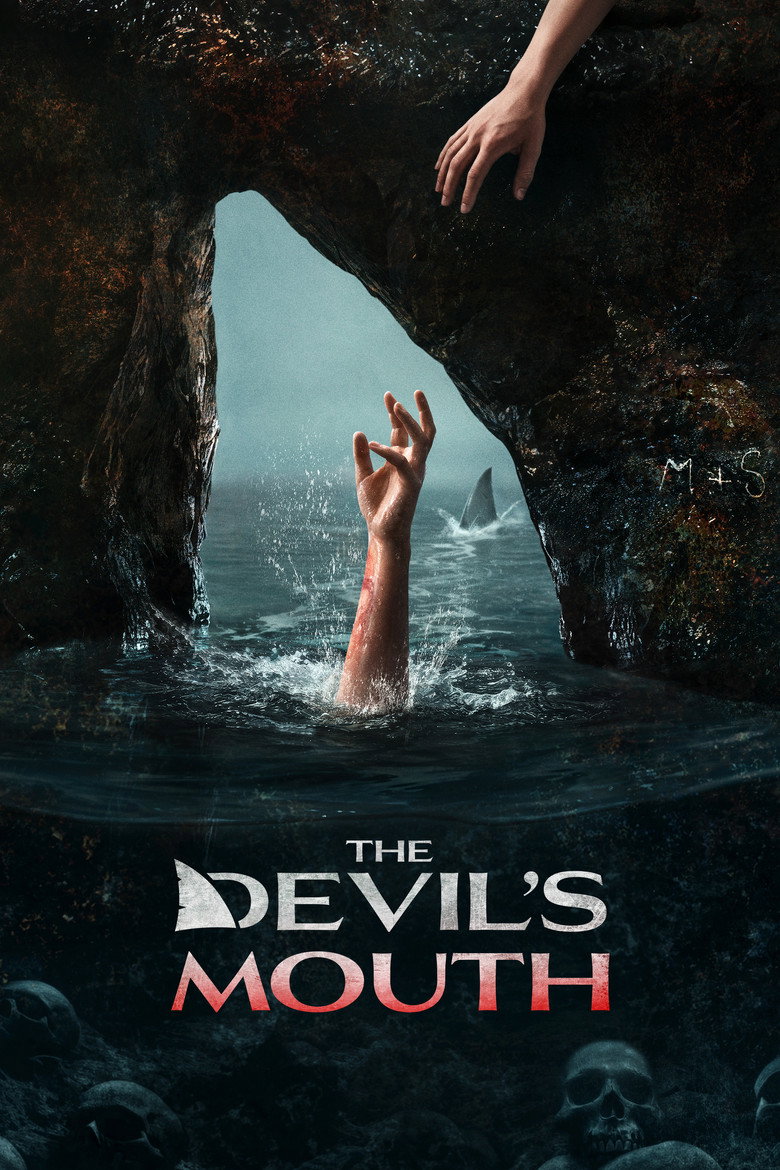
Director: Jeff Wadlow Screenplay: Aja Gabel, Myung Joh Wesner and Jeff Wadlow Cast: Kathryn Newton, Lana Condor, Nico Hiraga, Gavin Casalegno, Tommi Rose, Tayme Thapthimthong Year: 2026
I had been warned about this one and watched it anyway. After "Chum" I assumed I had already seen the worst shark cinema had to offer this year, and while "The Devil's Mouth" never reaches that level of disaster, it doesn't land as far from it as it should. It's a creature feature with a beautiful location and a problem no amount of scenery can fix: there isn't a single person on screen worth worrying about.
In "The Devil's Mouth" we follow Sara (Kathryn Newton) and a group of friends on holiday in Thailand. Among their planned activities is exploring a cave system with underground water, and the film takes its time establishing why the place means something to Sara: her father died recently, caving was one of the things he loved most, and he spoke about these caves as somewhere you had to go. It's an emotional anchor the film mentions once early on and then never returns to, which says plenty about how much the screenplay actually cares about its people.
The sub-genre is sharks in a confined space, and the mandatory comparison is "47 Meters Down: Uncaged" (2019), which does this exact thing with flooded caves and does it far better. That one was considerably less realistic, but it built tension with real craft and made you care who came out alive. Here the opposite happens. The entire first half is devoted to making the audience bond with this group, and the result is the reverse: they make so many avoidable stupid decisions that you end up on the shark's side. The problem concentrates in Max (Lana Condor), the toxic, manipulative friend who always needs the last word and always imposes what she wants; the others complain, disagree, and follow her regardless. Every misfortune in the film traces straight back to one of her calls, they get several chances to correct course, and each time they choose worse.
The performances don't lift the material either. Kathryn Newton, who has carried a lead elsewhere, seems to have one expression available here: there are scenes where horrific things are happening and her face stays in an almost cheerful register, completely disconnected from what the scene needs. It's the kind of mismatch that pulls you out of the film exactly when it most needs you to stay.
What does work is the place. I don't know whether the cave system was shot on location or built on a stage, but it looks beautiful, and the geography supplies some genuine claustrophobia: there's little space, and most of what there is happens to be water, which isn't exactly human terrain. The film also does a decent job explaining how a shark ended up inside that system. Where the explanation collapses is everything after. The animal moves through the caves as if it knew them by heart, and an ecosystem like that doesn't come close to the biomass needed to sustain a predator that size for the length of time that familiarity would imply. That it wandered in by mistake is credible; that it has lived there long enough to master the terrain is not.
In horror terms the film offers little. The attacks are simple, the tension never really tightens, and practically everything here has been done before and better elsewhere in the sub-genre. Several of the deaths are outright silly and hard to believe. And while a few shark shots hold up, in most of them it's far too obvious we're watching a digital animal, which in a creature feature is a foundational problem rather than a finishing one.
Collectors of shark cinema who have already worked through the rest of the sub-genre will find a pretty location here and not much else. Anyone looking for the tension of "47 Meters Down: Uncaged" will leave feeling they watched a screenplay that never decided whether it cared about its characters. "The Devil's Mouth" and "The Requin" are the same disaster with a different postcard: two shark films with no characters, no tension and not one idea of their own, where nothing survives except the scenery. I'll give the film the points it earns for its scenery, which is genuinely attractive, and not much beyond that.
Rating: 3/10
Ending Explained (Spoilers ahead)
The second half begins once the group is inside the cave system and the deaths start. The first to go is one of the friends whose relationship to the rest is never really established, followed by his girlfriend, another of Sara's friends who contributes little to the plot. Then the guide who brought them there dies, the same man who had warned them repeatedly that they needed to leave and couldn't push deeper. They pushed deeper anyway, on Max's call.
That leaves Sara, Max and Max's boyfriend, and with them a tension the film never resolves: the other two blame Max for everything that has happened, neither says it to her face, and Max carries on making the decisions despite her decisions being precisely what brought them here. While fleeing the shark along a route they believe leads out, Max's boyfriend ends up pinned under rocks.
Sara and Max, after a full loop, end up at exactly the point where they started. The only way out is climbing a cliff face, and on the far side there's a considerable drop onto rocks, so they decide to wait for the tide to rise. Max is badly injured and in no condition to climb, but insists, and Sara, rather than refusing, helps her up. The shark attacks and kills her in the attempt, dragging Sara along in the process. Sara breaks free and ends up dislodging an unstable rock that falls onto the animal and kills it.
The final scene shows Sara emerging from the cave and celebrating her survival, and that's where the ending comes apart. This woman has just watched four people close to her die, including the friend she had helped climb moments earlier. The coherent reaction is trauma, not elation. It's a generic close that leaves unresolved every tension the film had tried to build, and it confirms the underlying problem: the screenplay never worked out what it wanted us to feel about these people.
No comments:
Post a Comment