
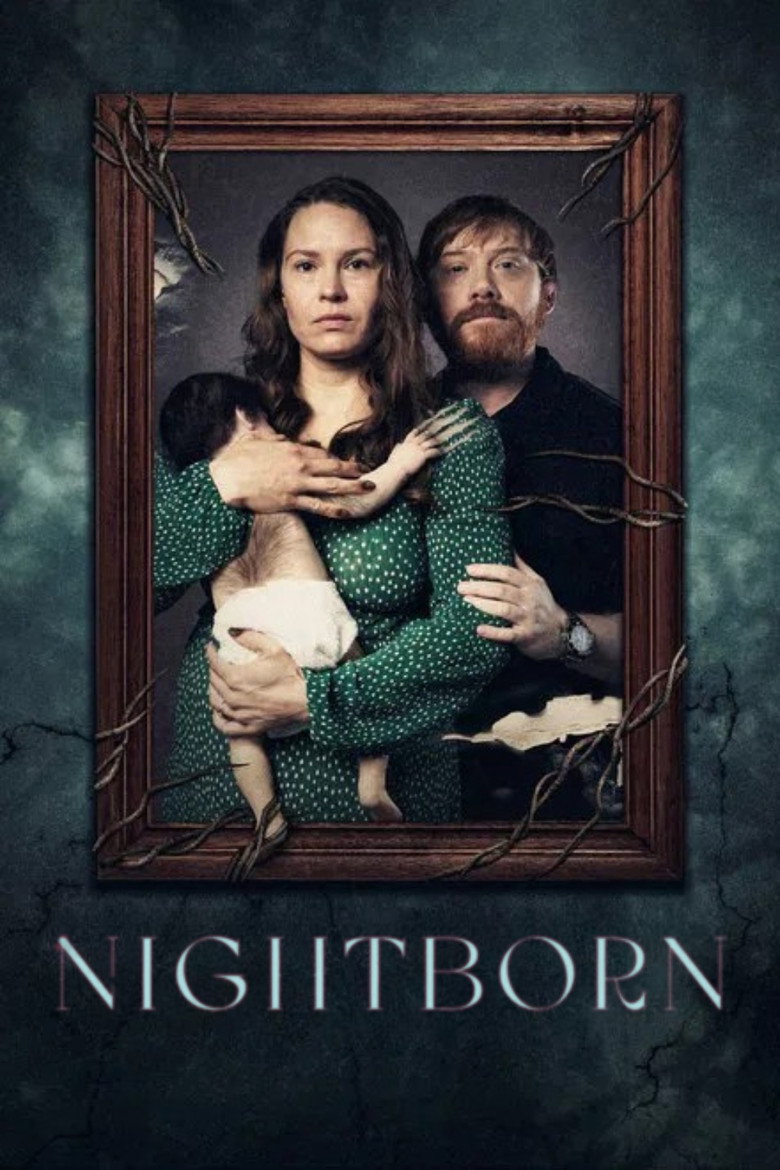
Director: Hanna Bergholm Screenplay: Hanna Bergholm, Ilja Rautsi Cast: Seidi Haarla, Rupert Grint, Pirkko Saisio, Pamela Tola Year: 2026
After the debut of "Hatching" in 2022, the open question about Hanna Bergholm wasn't whether she could make horror again but whether she could sustain her thesis. That first film worked the adolescent mother-daughter relationship through body horror; "Nightborn" takes the same thematic axis and shifts it toward brand-new motherhood, toward what happens when a woman gives birth and doesn't recognize her own child. It's a harder film to sell but a more ambitious one, and it confirms Bergholm as one of the European directors most consistently invested in using horror as a wrapper to talk about what motherhood actually costs.
In "Nightborn" we follow Saga (Seidi Haarla), a pregnant Finnish woman who moves with her English husband Jon (Rupert Grint) to an isolated house in the forest, the same house where she grew up. The place has been abandoned for years and nature has been quietly reclaiming it. Shortly after giving birth Saga begins to perceive her son as something that isn't a baby: a creature she senses but that no one else sees. The rest of the film tracks the dissonance between what Saga believes she's seeing and what everyone else registers as a common infant, while the forest seems to intensify its presence around the house.
The sub-genre "Nightborn" fits into is motherhood-as-horror, a line that has gained weight in the last decade through films like "The Babadook" (2014) by Jennifer Kent, "Prevenge" (2016) by Alice Lowe, and more recently "Huesera" (2022) by Michelle Garza Cervera. All work the same thesis from different angles: motherhood can be a territory of internal terror as intense as any external threat, and that terror rarely finds language outside genre fiction. Bergholm adds Finnish folklore to that tradition, specifically the figure of the troll, and that layer is what gives "Nightborn" its own identity within the sub-genre. Cold iron that burns, extreme light sensitivity, appetite for blood: every one of the baby's symptoms reads simultaneously as a hint that he's a troll and as a hint that he's Saga's hallucination.
Bergholm holds that ambiguity as a central aesthetic decision of the film. We almost never see the baby's face. He's shot from behind, in shadow, in half-light, with lights that fall away just before he'd be shown. The sounds he makes blend into the score until we can't tell if we're hearing an animal or an infant crying. Every scene is designed so the viewer doubts alongside Saga, and that doubt is the machinery of the horror. It's an exercise in visual restraint that separates Bergholm from most contemporary horror, where the temptation to show usually wins. Here restraint is thesis, not timidity.
Seidi Haarla carries the entire film. Her Saga is a character who dissolves scene by scene, and Haarla works each fracture with a physical precision that makes the descent believable. When Saga starts feeding the baby her own blood, when she begins to turn into something resembling the creature she thinks her son is, Haarla doesn't exaggerate; she lets the emotional weight do the work. Around her, Pirkko Saisio builds Saga's mother as a cold figure loaded with regret about her own motherhood and about the favoritism she showed between her daughters. It's a brief role whose echo runs through the entire film: Saga's difficult relationship with motherhood is rooted in what her mother taught her about what being a mother means. Rupert Grint as Jon delivers solid work in a role that asks something very different from what he was known for; it's interesting to see him in an adult, restrained part, without the franchise weight that defines him for most audiences.
The other technical protagonist is the forest. Bergholm films the nature surrounding the house as an active organism that wants in. Early in the film Saga and Jon are clearing out the place, pulling out roots, cutting branches that have crept through windows; as the film progresses and Saga's psyche deteriorates, the forest advances in parallel. It's a metaphor that reads without needing to underline itself, but one the film sustains with uncommon visual consistency. By the time the resolution arrives, nature has won its battle and the house barely distinguishes between interior and exterior. The horror isn't in the forest; the horror is that the forest was always waiting.
Fans of "Hatching" will find in "Nightborn" a natural thematic continuation, heavier and slower than her debut. Those arriving for explicit body horror will feel the first hour as patient accumulation before the film lands its strongest images. Anyone who values European horror that works the psychological from the inside, that engages with local folklore, and that trusts performance over effect, will find here one of the year's most dependable films. Bergholm keeps building an oeuvre, and this second entry confirms it wasn't a lucky debut.
Rating: 8/10
Ending Explained (Spoilers ahead)
The central revelation of "Nightborn" arrives in the last act and reorients everything we've seen. When the chaos breaks out inside the house and only Saga and her son remain, face to face with the camera for the first time without evasion, we finally see the baby head on. He isn't a creature. He isn't a troll. He's a perfectly normal child. What that shot dismantles, though, isn't the events themselves but the frame Saga had been reading them through. The symptoms happened, and there were witnesses: other characters noticed the iron burn and the light sensitivity, and the attack on another family member played out in front of everyone. The film is careful not to reduce all of it to hallucination, and that gap between what Saga saw and what Saga concluded is where it lives. What stays open is the cause: whether something genuinely inexplicable was in that house, or whether every symptom had a mundane explanation that Saga's condition kept organizing into folklore until it cohered. The reading the film pushes hardest is the second, postpartum depression taken to its most extreme consequences, but Bergholm deliberately withholds the confirmation that would make it certain.
That reading is what gives weight to the details the film had been seeding. The baby's sensitivity to light could read as troll trait or as a common dermatological condition in newborns. The iron that burns could be folklore or an allergic reaction. The appetite for blood, in the film's actual reality, might have been a baby that bit during breastfeeding like any other, magnified in the mind of a mother no longer seeing clearly. Bergholm plays with ambiguity throughout so the viewer loses their footing too, and the purpose of that ambiguity only reveals itself with the child's face at the end. The film isn't doing folk horror; it's doing a clinical portrait of a postpartum psychiatric crisis dressed as folk horror so it becomes possible to look at.
Jon's death in the resolution isn't incidental. Her husband, who had tried to hold the situation together from outside without really understanding what Saga was living through, dies when the forest finally breaks all the way into the house. In literal terms it's a nature attack; in the film's reading it's the consequence of having ignored what was happening inside Saga until there was no way back. The film mentions in a late line of dialogue that divorce rates spike during the first year after a first child's birth, and that line isn't there by accident: the film builds its entire tragedy on that statistic, on what happens in relationships when the new mother enters postpartum depression and the support system doesn't recognize it in time.
The maternal inheritance is the other piece the ending illuminates. Saga's mother appears in few scenes, but each appearance carries contempt for what motherhood required of her and an open favoritism that damaged her daughters' relationship. Saga had carried into her pregnancy a conception of motherhood as loss, as renunciation of her own life, and that conception is the emotional ground on which the postpartum depression built its psychosis. Bergholm isn't saying Saga's crisis is her mother's fault; she's saying motherhood doesn't happen in a vacuum, that women carry what they learned about being a mother long before becoming one, and that postpartum depression finds fertile ground in that prior weight. The film ends with Saga and her son alone in the forest, in a state that is no longer conventional motherhood but also isn't what Saga believed she was seeing. It's an ending open in its emotion and closed in its thesis: motherhood can become a woman's worst internal territory, and society almost never recognizes it in time.
No comments:
Post a Comment