
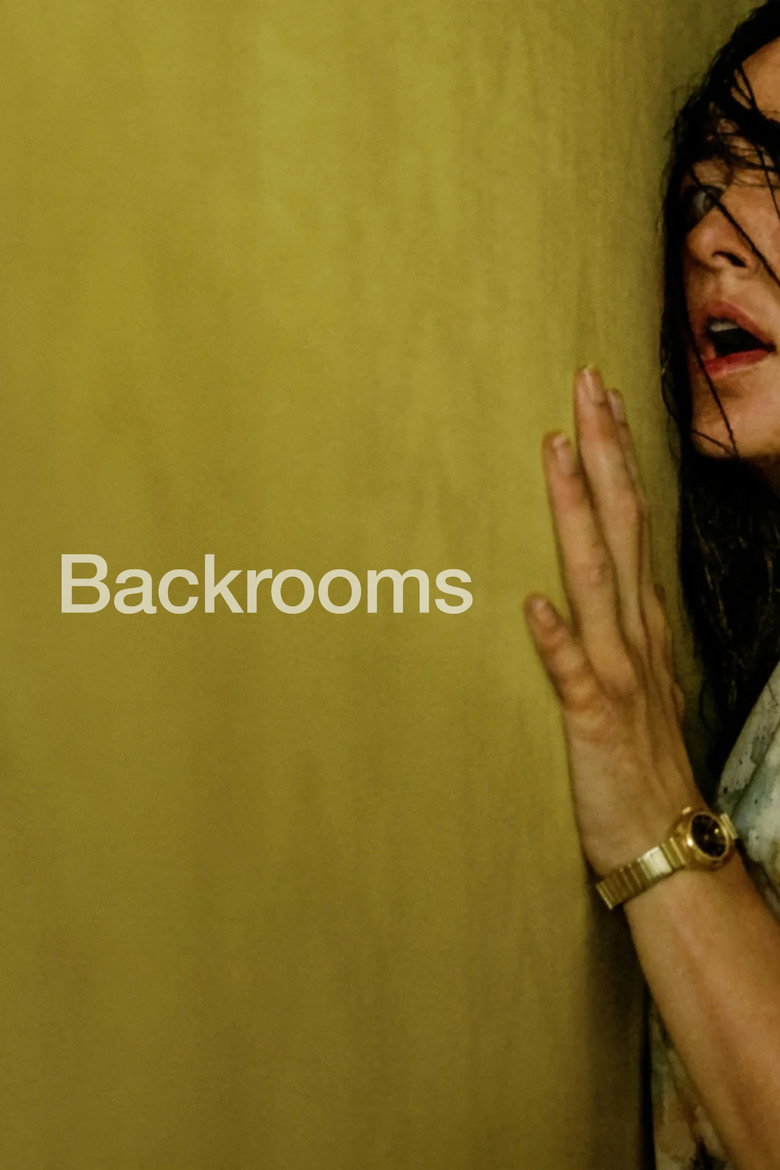
Director: Kane Parsons Screenplay: Will Soodik and Kane Parsons Cast: Chiwetel Ejiofor, Renate Reinsve, Finn Bennett, Lukita Maxwell Year: 2026
The Backrooms began as a creepypasta and slowly cemented itself online — first as viral image, then through Kane Parsons's (Kane Pixels) videos, which gave the mythology its definitive visual identity, and more recently through a constellation of games and interactive experiences that expanded the idea of a space that stretches infinitely and shouldn't exist. Few horror myths have travelled that far from forum to feature without losing what made them work. "Backrooms" is the film that closes that circle, and it does so with the ambition of turning the internet-native phenomenon into auteur horror cinema.
In "Backrooms" we follow Clark (Chiwetel Ejiofor; "12 Years a Slave"), the owner of a furniture store who starts noticing strange things in his shop — until he discovers that one of the walls isn't quite solid. Passing through it, he arrives in an immense space with the aesthetic of an abandoned office or an endless warehouse, filled with objects that resemble the real world but are slightly wrong: sizes don't match, arrangements are off, the logic is one degree bent. Clark becomes obsessed. He begins to enter routinely, tries to map the place, looks for someone who will believe him. His psychologist Mary (Renate Reinsve; "The Worst Person in the World"), who's been treating him since his divorce, becomes the only person he dares to tell.
The first thing to say about "Backrooms" is that it's psychological horror wearing the clothes of liminal space horror. The aesthetic works — the fluorescents, the endless corridors, the impossible-to-place echo — but the real engine of the film is closer to "The Shining" than to any first-person walking simulator like some of the games that expanded the central idea of the myth. The space isn't the threat; it's the projection. And that distinction is what separates Kane Parsons from the army of shorts and fanfilms that have spent years circling the same material.
The visual work carries a responsibility the film takes seriously. Every corridor is composed with symbolism: repetitions of Clark's store, echoes of his home, fragments of the life he left behind. The Backrooms feel familiar because they're made from his own memories that he isn't looking at head-on. The sound design seals it: you never know where a noise comes from, whether it's a threat approaching or the background hum of machinery, whether you're moving away from danger or into it. In a space that aesthetically should be the opposite of claustrophobic — huge, lit, empty — the film delivers constant claustrophobia.
The internal logic of the place is what elevates the film most. The Backrooms aren't the same for everyone who enters; they adapt to each person's history, to their memories. Creatures that only appear for certain visitors, manifestations that respond differently depending on who's in front of them, spaces that reconfigure according to the private fears of whoever steps into the corridor. That mechanic lets Parsons build a film that's simultaneously pure horror and character study — because everything Clark sees in the Backrooms is telling us something specific about Clark, not about the space.
The horror scenes work despite the premise lending itself more to slow burn. There are jumpscares — well-earned, built through the combination of visuals and sound, not slapped on — and there are moments of contained but effective violence. But the most uncomfortable thing about the film isn't the scares: it's the permanent sense that something is wrong with the space, and that discomfort is what sustains the tension across the runtime without needing to lean into gratuitous violence or gore.
Ejiofor carries almost the entire film on his shoulders and never breaks. His curiosity, his frustration with the outside world, the aggression he drags from the divorce, and the fascination that starts to look like addiction with the place — it all reads on his face and in his body without him needing to explain any of it. It's exactly the kind of performance an auteur horror film needs to sustain the symbolic weight it carries.
Worth mentioning that "Backrooms" leaves out many elements that became canonical to the online myth, and the story's ending stays deliberately open — clear signs that Parsons is flirting with one or several sequels. The choice is coherent: trying to cram the entire internet-native universe into a single film would have diluted what makes this specific version work, and leaving the door open lets him return to this space when he has something new to say about it.
Fans of psychological horror and liminal space horror will find here the best cinematic translation of the myth to date. Those arriving looking for explicit horror or slasher will feel the film moved onto a different track — but it's a track that knows exactly where it's going, and one that commercial horror rarely dares to travel.
Rating: 9/10
Ending Explained (Spoilers ahead)
What the film makes explicit in its last stretch is that the Backrooms were never a place; they're the topography of a psyche — not the psyche of some generic person who walks through the wall, but of the specific person who does. Kane Parsons takes the internet-native mythology — the endless corridors, the fluorescent light, the sense of having been here before without remembering when — and reconfigures it into something far more uncomfortable than a cursed space: he turns it into the map of what one doesn't want to look at inside oneself; the confrontation with one's most personal and hidden memories and fears. Every object slightly out of place is a memory the person repressed. Every corridor that leads nowhere is a conversation the person never finished. The horror of the liminal space becomes literal psychological horror, and that translation is the film's specific contribution to the canon.
The entity that pursues Clark isn't an external threat; it's the part of him he's been denying his entire adult life. The rage he took out on his wife, the aggression that cost him his marriage, the inability to accept that he was the problem — all of it takes physical form in a place where he can't look away. But the film refuses to make that reading morally simple. The entity — Captain Clark — up close, isn't just violent Clark. It has flashes of the other Clark, the one asking for help but who doesn't know how to ask, the one who knows something in him is broken but can't articulate it. The Backrooms don't punish him for being a monster — they give him back the full image of what he is, including the part of him that wants out of that. It's the most humane read of what, in less careful hands, would have been a cosmic-revenge finale.
The psychologist is the character who gives everything else its weight. Throughout the film Clark has been looking to her for a validation she was never going to give; she has been trying to walk him, with the patience the job demands, toward the one conclusion he has to arrive at on his own — that the responsibility for what happened to his marriage is his. The Backrooms end up doing her work by traumatic route, literalizing what therapy would have taken years to construct. The cruel elegance of the ending sits there: Clark reaches the same point she'd been pointing at from the start, only he reached it while being chased by a monstrous version of himself through infinite corridors, and the consequence of not having faced it in time is fatal. The truth didn't change; only the price he had to pay to hear it did.
No comments:
Post a Comment