
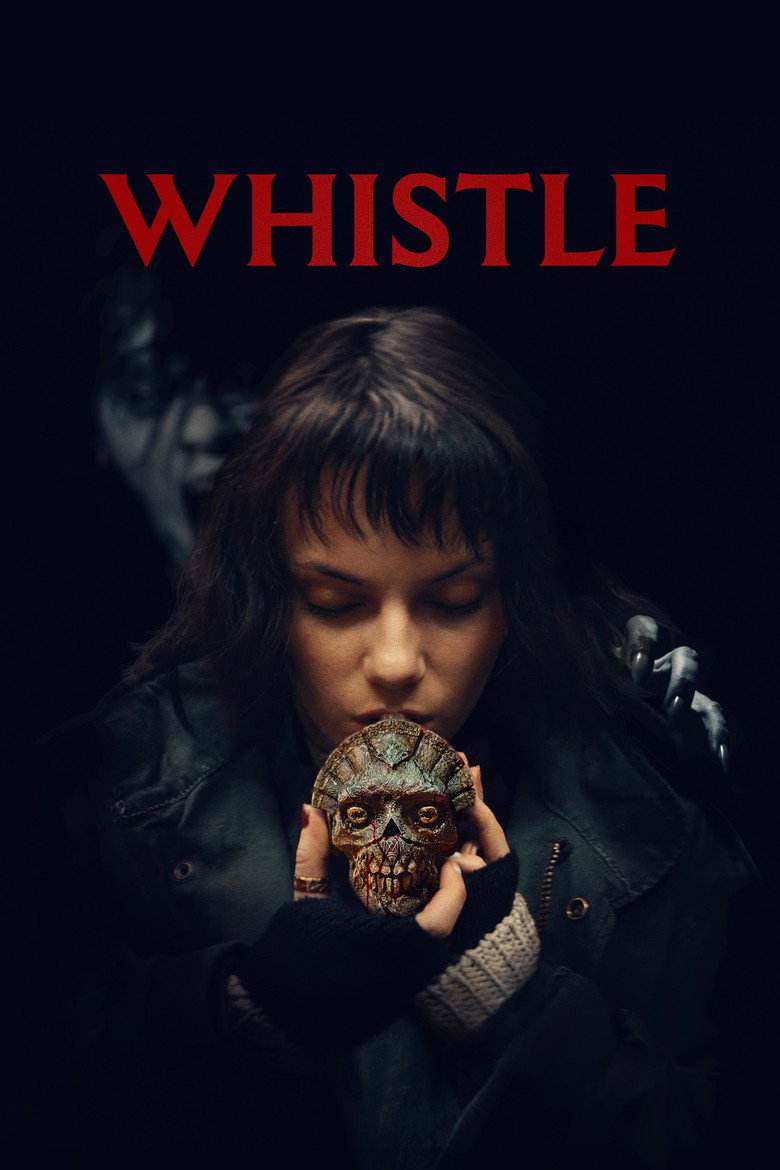
Director: Corin Hardy Screenplay: Owen Egerton Cast: Dafne Keen, Sophie Nélisse, Sky Yang, Jhaleil Swaby, Percy Hynes White, Nick Frost Year: 2026
I really wanted to like "Whistle", and I went in with expectations, because the idea of a cursed object that summons the death of whoever uses it has a whole tradition of teen horror behind it, running from "Final Destination" to "It Follows", and in the hands of Corin Hardy ("The Hallow", "The Nun") it promised a lot. I can't call it a bad film, but it doesn't come close to meeting those expectations either, and much of the problem shows up fairly early, once it becomes clear the film isn't going to make me care about its characters.
In "Whistle" we follow Chrys (Dafne Keen), a young woman who moves in with another branch of her family and starts a new life somewhere unfamiliar, and who at her new school is assigned the locker of Mason, the student the film opens with, whom we see being stalked by an entity that ends up killing him. Inside that locker Chrys finds a whistle, a handcrafted object of apparently indigenous origin, which first ends up with a teacher who blows it on his own and then makes its way back to Chrys's group of classmates, where someone decides it would be a good idea to blow it again. From that moment on they all start experiencing paranormal events and sensing an entity stalking them, because the whistle does nothing less than summon the death of anyone who hears it ahead of schedule.
The most interesting thing about "Whistle" is exactly how it handles that concept, because death doesn't show up in just any form, but in the image of the way each person was going to die anyway, like a preview of their own fate. That gives the film its best moments, which are its deaths, genuinely creative because the victims experience the death that was waiting for them even when the circumstances aren't there, like someone destined to die in a traffic accident who takes every single impact without any vehicle to cause it. It is the clearest inheritance from "Final Destination", with that idea that death has a plan and escaping it only postpones it, and on the whole those scenes look quite good, because the effects are solid, even if a few CGI moments don't hold up as well.
The problem is everything surrounding those deaths. The characters make one stupid decision after another throughout the film, which makes it hard to care what happens to them, and one in particular, Rel, Chrys's cousin, struck me as insufferable and unrealistic, especially in his determination to win over one of the girls in the group who already has a boyfriend, which he attempts right in front of the boyfriend, something that in real life either wouldn't happen or would end very badly. It doesn't help that the film handles its own rules so poorly, since the curse's timing is inconsistent and not everyone who invokes it suffers it at the same pace, or that it leans on a character who exists almost entirely to explain to the protagonists whatever the script needs them to know, a pretty cheap way to move the story forward.
I found the performances a little weak, slightly below average, though I think that has more to do with Owen Egerton's script and the direction than with the actors, who include Sophie Nélisse ("47 Meters Down: Uncaged") and Percy Hynes White ("Our House"). Another thing I struggled with is that the film is set in a high school, yet none of the characters look like high school students, since they all look like adults, and that undercuts the credibility of the whole story.
"Final Destination" fans who mostly enjoy creative deaths will find something to salvage in its 100 minutes, while anyone who needs characters they care about, or a curse with rules that hold together, will probably come away pretty frustrated.
Rating: 4/10
Ending Explained (Spoilers ahead)
The film opens with the death of Mason, who bursts into flames after a game, and later Mr. Craven (Nick Frost) confiscates the whistle from Chrys and blows it on his own, before any of the students do, and dies that same day, crushed by an apparition of himself in the image of a patient with advanced lung cancer, which was how he was destined to die. It is Ivy, Mason's grandmother, who explains that this is an Aztec death whistle and that there is a way to cheat it, by marking another person with your blood while your death is near in order to pass it on, which makes little sense given that she herself lost her grandson, and by her own account her daughter too, to the whistle. One by one the teenagers die, and Rel tries to save himself by marking Noah, a supposed youth pastor who actually sells drugs to teenagers, with his blood, but Chrys and Ellie stop him, and Rel ends up torn apart by his own death.
In the end, Chrys and Ellie conclude that you can only die once, so they plan to stop each other's hearts with an injection, so that death assumes it has already claimed its victim, and then revive each other with a defibrillator, but Ellie ends up tricking Chrys and injecting her first. While Ellie is trying to resuscitate her, Noah shows up looking for revenge, opens fire, breaks the defibrillator and wounds Ellie in the side. At the same time, Chrys is fighting her own death, which wears her face, as if she were underwater trying to swim to the surface while being dragged toward the bottom, until Ellie remembers a line from Ivy, that death is inevitable but living is up to you, and that line, which I think is pretty bad, is what pushes Chrys to fight and come back. When death closes in on Ellie, Noah unknowingly touches the blood she is losing, and that is enough for death to switch victims and take him instead, an ending that is meant to be satisfying because the film sold him as the villain the whole time, but whose execution leaves a lot to be desired.
Three months later, Chrys and Ellie are together and everything seems back to normal, until a new student finds the whistle in her locker, and in a mid-credits scene, instead of playing the violin in front of the school, she takes the stage and blows it in front of the entire auditorium, dooming everyone present. I find that ending absurd, because no musician stands in front of an audience to play an instrument they just found and have never played.
No comments:
Post a Comment