
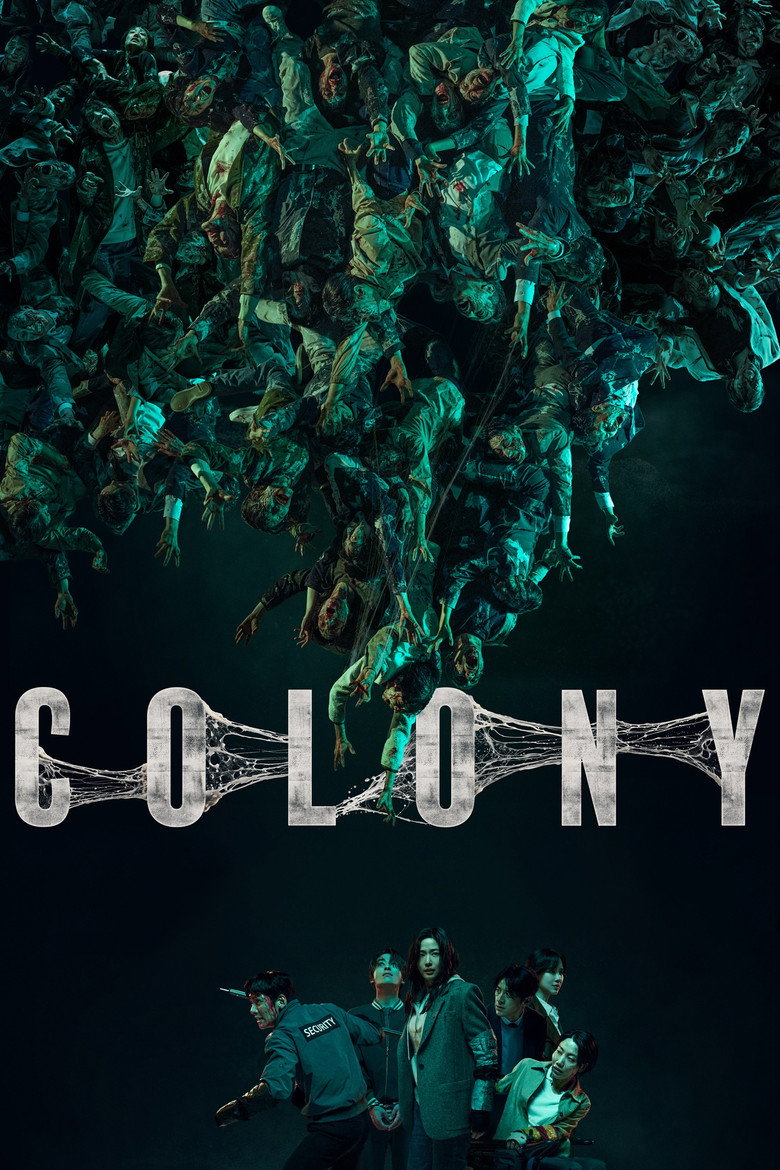
Director: Yeon Sang-ho Screenplay: Yeon Sang-ho and Choi Gyu-seok Cast: Jun Ji-hyun, Koo Kyo-hwan, Ji Chang-wook, Kim Shin-rok, Shin Hyun-been, Go Soo Year: 2026
When "Train to Busan" came out, horror fans, myself included, hailed it as one of the best zombie films ever made, a claim I still stand by and one that put the whole genre's attention on its director, South Korea's Yeon Sang-ho. His return to that same world with "Peninsula" was a considerable step down from what "Train to Busan" had been, which is why I was curious to see what he would do with "Colony", the film that brings him back to the zombie sub-genre and reminds everyone why he is considered one of the most important directors in recent horror.
In "Colony" we follow Se-jeong (Jun Ji-hyun), a biotechnology professor and researcher attending a conference in a building where a virus is released that, once it enters a person's system, all but turns them into a zombie. With the building sealed and a group of survivors trapped inside, Se-jeong and the others discover that the infected are not mindless creatures, because they can communicate with one another through a network of fluids and fungi that lets them learn and evolve as they are exposed to new situations.
That idea struck me as a fresh way to revive the sub-genre and, along the way, a somewhat more believable one. Zombies have often been tied to bioweapons and bioterrorism, as the first "Resident Evil" already was, so that part is nothing new, but modeling them on organisms that exist in nature and communicate in ways completely unlike ours is. One of the rules that has always defined zombies is that they lose their intelligence, and that loss is usually the edge that lets humans survive, but here the infected lose it only to slowly win it back, building knowledge from what they experience and what they pass between one another.
What I liked most is that while the zombies learn from what they see, the humans are also learning how these new creatures work. Early on there is a stretch devoted to setting up the rules, in which we watch the survivors start to figure out how the infected learn and where their limits lie, and how they turn that knowledge to their advantage to escape the attacks, which I found clever. The visual side holds up as well, because the zombies look convincing and terrifying, especially when the camera lingers on them, and the violence is explicit and feels real. Add to that the use of confined spaces, something Yeon Sang-ho had already mastered with the train in his most famous film, and which here concentrates the whole story inside a building packed with people, making it more claustrophobic and more dangerous.
Although the film runs 123 minutes and is a little long, it never feels boring or stretched, because every scene is quite deliberate and keeps the tension up. There are also some more emotional threads that help build a sense of danger and make us care about the characters, and that kept me engaged throughout. The film also offers an interesting critique of how humans communicate, with a strong emphasis on failed communication in both its dialogue and its story, because communication is at once what allowed us to become the dominant species and the root of the misunderstandings and conflicts that end in tragedy, and in war if we take it a step further.
Where "Colony" fails is in what it does with its best idea, because after establishing these creatures as a dangerous force that learns at a frightening pace, it reaches a point where it sets that idea aside to focus on a far more familiar kind of threat, one in which what is scary is once again the sheer number of zombies and the violence, not the intelligence they keep acquiring. That is where it slides back into the usual sins of zombie cinema, things we have seen many times before, and loses the freshness it started with, which feels like a missed chance to explore an idea that was developing very well up to that point.
"Colony" will always be compared to "Train to Busan", a masterpiece that is very hard to top even for the director who made it, and while that comparison is a little unfair it is also inevitable, and by that measure it falls well short. Compared with the rest of zombie cinema, on the other hand, it sits a bit above the average good entry in the sub-genre and far above the many soulless zombie films that are more embarrassing than anything else. Zombie fans looking for a different premise will enjoy it, while anyone expecting another "Train to Busan" will probably walk away disappointed.
Rating: 7/10
Ending Explained (Spoilers ahead)
The outbreak begins during a biotech company's presentation, when scientist Seo Young-cheol (Koo Kyo-hwan) injects the CEO with a mutated slime mold after accusing him of stealing his research, although it later emerges that his real motive was revenge on Se-jeong, whom he deliberately invited to the event, because she had exposed his father for embezzlement and that drove his father to suicide. Se-jeong, who had come to the conference hoping her ex-husband, Han Gyu-seong, would help her land a job, ends up teaming with his current wife, the researcher Gong Seol-hee, who helps her by phone from outside the building.
The survivors first believe Young-cheol has the vaccine, but they discover he let himself be bitten on purpose and can see through the eyes of the infected and control them completely, so the colony depends on him. Meanwhile his horde keeps growing, since every person they come across is attacked and joins the colony, like an army growing exponentially. Se-jeong stops them by disguising herself with a mycelium-covered jacket and throwing it over one of the infected, which makes hundreds of them merge into a single collective and triggers a sensory overload that crashes their shared system and reduces them to a primitive state. In the chaos, the horde pushes Young-cheol into a burning car and he dies, and with his death every infected person in the city freezes in place.
At the very end, as Se-jeong and Seol-hee discuss how to explain what happened to the public, one of the frozen infected moves. The film doesn't make clear whether it is an involuntary twitch or whether these zombies have already developed some individuality and no longer need a leader to direct them, but it does leave the door open to a sequel that explores what this colony could become if it learns to communicate and evolve on its own.
No comments:
Post a Comment