
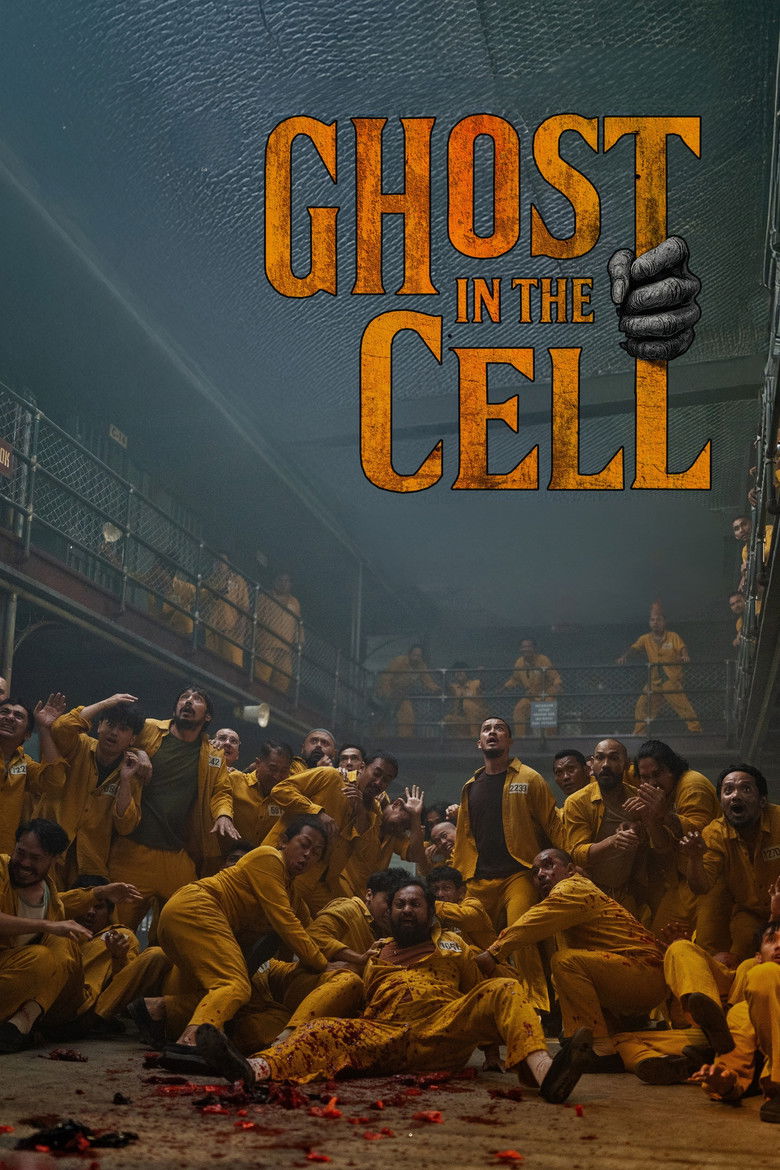
Director: Joko Anwar Screenplay: Joko Anwar Cast: Endy Arfian, Abimana Aryasatya, Bront Palarae, Lukman Sardi, Morgan Oey, Tora Sudiro Year: 2026
Indonesian horror has been delivering some of the genre's most interesting work for several years now, and Joko Anwar has had a lot to do with that, both behind the camera on "Impetigore" and as the writer of "The Queen of Black Magic". So I came to "Ghost in the Cell" with expectations, and unfortunately they weren't met, since what starts as a horror film with real potential ends up losing itself in comedy that never managed to connect with me.
In "Ghost in the Cell" we follow Dimas (Endy Arfian), a journalist who one night hands his boss an article his boss isn't happy with and asks him to rewrite. That same night the boss had fought with his wife and was also carrying the stress of a newspaper on the verge of bankruptcy, and in that moment he is attacked by an entity nobody can identify, one that tears him apart with brutal ferocity and leaves him hanging from the office ceiling fan. With no one else to blame, the blame lands on Dimas, even though it's obvious that no human, let alone someone like him, could have done such a thing. Dimas is sentenced to prison, and shortly after he arrives the inmates start dying in strange ways while a group of them tries to get to the root of what's happening.
The film starts out quite well, with very explicit, well-executed gore and an interesting plot, and although it loses momentum at times and introduces elements it never develops, it holds together through its first stretch. One of its strongest points is its social critique of how things work in Indonesia, and I always appreciate it when horror uses its tools to talk about a country's social problems, so this is a clear point in the film's favor.
The problem is where it goes next, because "Ghost in the Cell" opens on a serious note, as horror played straight by every rule, and gradually leans toward comedy. At first that's fine, as the comic moments didn't bother me, though I didn't find them very funny either, and that may be a cultural thing. But after a discovery the characters make halfway through, comedy becomes the center of everything, and at some point it gets genuinely grating, since it produces more secondhand embarrassment than laughs. It pulled me out of the film completely, and I feel the path it was on until then was far better than the one it chose.
On top of that there are several exposition scenes that don't work either. They dump a pile of information all at once, and you can tell someone realized it mattered to the plot and simply found somewhere to put it, without it ever feeling worked in. The same goes for the resolution, which doesn't feel like something the characters discover or that the story leads them to, but like something that suddenly drops into the plot and that the film decides to follow, as if the script no longer knew how to continue and chose to wrap things up however it could.
The gore has its ups and downs, as much of the time it looks very good, but at other moments it leans on CGI, and that CGI looks pretty bad. There's a clear attempt to get creative with the way the ghost kills, given that almost every death is staged like a work of art, gruesome and explicit executions composed almost like a painting. The problem is that this idea has absolutely nothing to do with the ghost, its identity or the plot, so it feels like something someone wanted to film and wedged in purely for the shock.
At 106 minutes the film runs far too long, and much of that runtime goes to comedy that could have been cut, because it adds nothing to the story and only stretches out what was already weak. Those who enjoy horror that mixes explicit gore with absurd humor, or are drawn to the social critique Anwar works into it, may get something out of it, while anyone arriving in hopes of the serious horror of "Impetigore" will walk away disappointed by a weak film with a forced resolution and plenty of plot holes.
Rating: 4/10
Ending Explained (Spoilers ahead)
The discovery that shifts the film's tone is that one of the inmates can see the aura each person carries, and he notices that everyone who has died in the prison had a red aura right before their death. Putting the pieces together, the group realizes those people were going through a moment of intense frustration or rage, something weighing heavily on them, and that this opened the door to the entity as a vessel for their violence. In hindsight, that explains the night Dimas's boss died, with the fight with his wife and the newspaper about to go under.
From there the inmates realize they need to keep their auras in check, and that they can do it by making something artistic or doing something religious, like praying. That's the point where the plot starts to stretch, and it's also the basis for all the comedy that follows.
In the end they discover that the ghost wants to kill someone inside the prison, and that it latched onto Dimas in order to get in, and once again this arrives with a lot of explanation. Its target is a jailed politician who lives in another section of the prison, in a cell that is practically a luxury apartment, and what the group has to do is get close enough to him and make him angry so the ghost can kill him. They pull it off, the politician dies and the ghost stops stalking them.
Shortly afterward Dimas is acquitted, thanks to security camera footage showing that he wasn't in his boss's office when the man died. The social reading is there, in a politician who lives in privilege even behind bars, but the film reaches it in such a forced way that the ending doesn't feel like a payoff, more like an exit.
No comments:
Post a Comment