
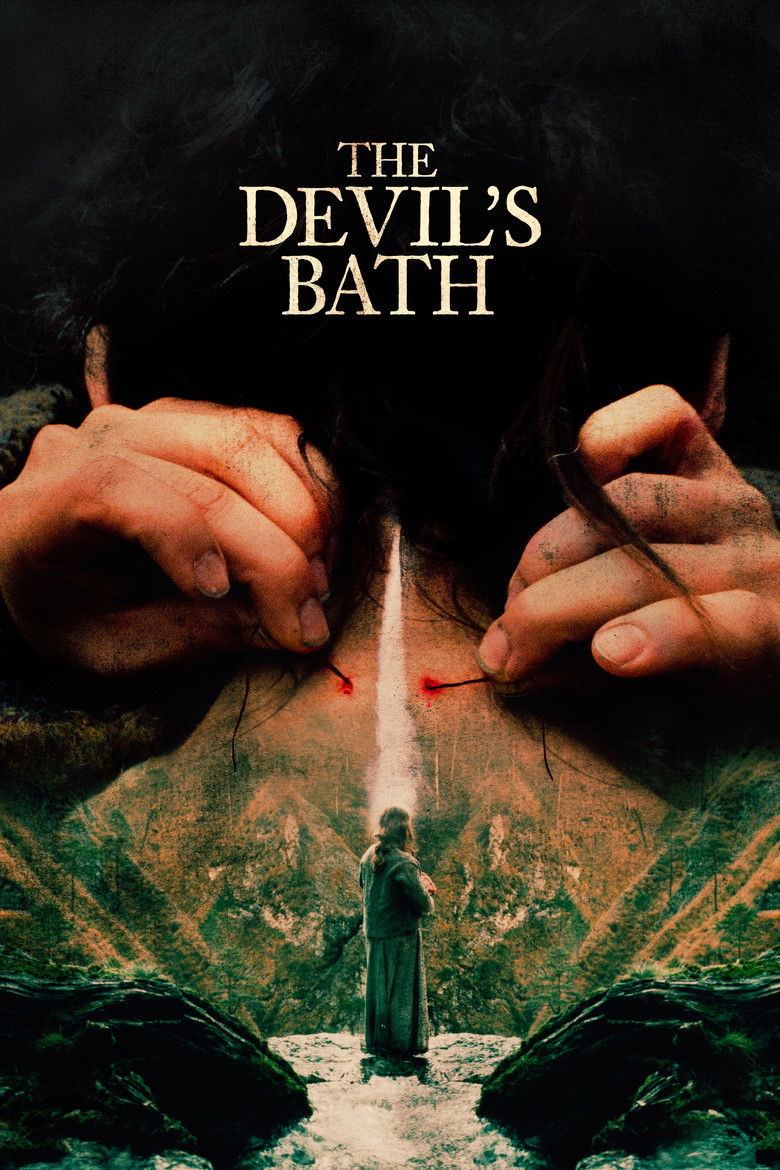
Director: Severin Fiala, Veronika Franz Screenplay: Severin Fiala, Veronika Franz Cast: Anja Plaschg, David Scheid, Maria Hofstätter Year: 2024
Severin Fiala and Veronika Franz have been building a slow, Austrian horror filmography since "Goodnight Mommy" (2014) and "The Lodge" (2019), and "The Devil's Bath" is their most thematically ambitious return. The film takes a documented historical phenomenon almost no fiction has approached, frames it inside the rural Catholicism of 18th-century Austria, and delivers it with the visual austerity that has become their signature. The problem is that austerity this time crosses the line from formal rigor into sustained tedium, and the film ends up harder to recommend than its premise deserves.
In "The Devil's Bath" we follow Agnes (Anja Plaschg), a young woman who has just married Wolf (David Scheid) and moves from her native village to his, in the rural Austria of the 18th century. The transition doesn't go well. Married life doesn't resemble what she had imagined, her mother-in-law (Maria Hofstätter) controls the household with a firm hand, Wolf neither seeks her out sexually nor seems interested in having children with her, and Agnes begins to accumulate a frustration that neither the village's Catholicism nor her husband's apparent indifference can contain. Shortly after her arrival she starts fixating on the executed remains of a village woman that had been left on public display, and that fixation marks the line along which Agnes slides for the rest of the film.
The sub-genre "The Devil's Bath" inhabits is rural historical horror, a European tradition running from "The Witch" (2015) by Robert Eggers through more recent pieces like "Saint Maud" (2019) by Rose Glass. What Franz and Fiala add to that line is a documented premise cinema has barely touched, and the film's most interesting structural decision is its refusal to explain it. The film never names the historical phenomenon it is built on; it lets it operate as a pressure Agnes understands and the viewer does not, and that asymmetry is what sustains the discomfort across the runtime. Where Eggers and Glass externalize evil into a witch or a delirious faith, here the mechanism is doctrinal and social: what closes in on Agnes isn't an entity, it's a village, a church, and a set of rules about what a woman is supposed to be. The film trusts that the historical weight will be felt before it is understood.
Technically the film is impeccable. Martin Gschlacht signs a 4:3 cinematography that isolates Agnes in the frame with painterly precision; interiors are lit by natural or candlelight, exteriors capture the Austrian forests and rivers in a desaturated palette that turns landscape into an active character. Sound design mirrors this: long silences, insects, river water, occasional religious singing, almost never incidental music. Anja Plaschg carries the entire film with a completely interior performance; Agnes barely speaks, but every look, every held gesture, communicates the collapse the plot asks for. It's exactly the kind of acting work festivals reward.
The problem is the pacing. "The Devil's Bath" runs 121 minutes and could easily run sixty. Franz and Fiala take their time establishing Agnes's daily life with a patience that in other directors reads as rigor and here reads as redundancy: similar scenes repeat with minimal variation, the plot advances in almost imperceptible increments, and the film loses emotional traction long before it reaches its final act. For the viewer who values slow cinema as form, the film may sustain interest; for the one who needs some dramatic acceleration, the first hour feels like an endurance test without clear payoff. Franz and Fiala had proven in "The Lodge" (2019) that they knew how to dose slowness without losing the viewer; here they overplay their hand.
In strictly horror terms, "The Devil's Bath" offers very little. The opening scene (a woman throwing a baby off a waterfall) and the view of her executed remains are the two strong images of the film, and those two images carry almost the entire weight of the genre. The rest is a period drama about a woman deteriorating psychologically in a suffocating environment, and while that drama has merit, it isn't the horror the premise promises nor what Franz and Fiala had been cultivating. Fans of explicit horror will feel let down; those looking for period drama with solid historical texture will find far more than they came for, only without the label the marketing campaign promised.
For the viewer who values rigorous historical debuts, restrained performances, and cinematography as visual argument, "The Devil's Bath" may compensate for its pacing friction. For anyone arriving expecting the Austrian horror Franz and Fiala had been cultivating, the film will read as a detour into festival drama, made with craft but without the tension their prior work had sustained. I would have preferred less landscape and more engine. It's a piece one admires more than one enjoys, and that distance is finally what places it far from the year's best.
Rating: 4/10
Ending Explained (Spoilers ahead)
The film closes with an on-screen text card explaining the historical phenomenon the film had been implying without naming until that point. In 18th-century Catholic Europe, especially in rural German-speaking areas, a documented practice existed called suicide by proxy: people who wanted to die but believed direct suicide would eternally damn them committed a crime that would guarantee capital punishment, usually the murder of a child, since infants were considered saved by baptism. Before the execution, the condemned received sacramental absolution for their sins. They died, in their theological logic, without the stain of suicide. This is the foundation on which Agnes's entire arc rests, and it is also the explanation of the opening image: the woman who throws the baby off the waterfall at the beginning of the film wasn't an indifferent murderer, she was another woman from the same village seeking the same exit that Agnes would seek later.
Agnes's arc is that same path in slow-motion form. The depression the film documents across nearly two hours ultimately leads her to the same point the opening woman occupied. Agnes abducts a child, kills them, and turns herself in to be executed after receiving the church's forgiveness. The film gives this execution the visual dignity it had been holding in reserve; Franz and Fiala film the event with an almost ritual composure, neither underlining the horror nor diluting it. It is, for what the film has been building toward, the most accomplished scene in the movie, and its weight comes precisely from the historical context the film kept hidden until the end. If the informational text had appeared at the start, the film would read as history; appearing at the end, it forces a rereading of everything before.
The coda after the execution is the element that feels least integrated. After Agnes is executed and her remains are placed on public display just as the opening woman's were, the film shows village inhabitants approaching to collect her blood. The reading Franz and Fiala seem to propose is that the blood of the executed was considered a healing or protective relic within popular superstition, something rural Catholicism tolerated despite the theological contradiction. It's a historically plausible detail, but the film had never prepared it earlier, and it arrives as a vignette that widens the frame after the film has already closed its emotional arc. The folk horror element that coda hints at doesn't appear anywhere else and doesn't change the film's reading, so it works more as a footnote than as structural piece.
What remains at the end is a film with a genuinely novel premise inside contemporary historical horror, executed with impeccable technical craft, anchored by an actress who carries all the emotional weight, and sunk by pacing decisions that prevent it from taking advantage of any of those strengths. Franz and Fiala know what they're doing; the problem is that this time they did it for too long. The real history behind the film deserves the film this one doesn't quite become, and that distance between what the premise promises and what the execution delivers is what sums up "The Devil's Bath": a lot of craft, little engine, one hour of runtime too many.
No comments:
Post a Comment