
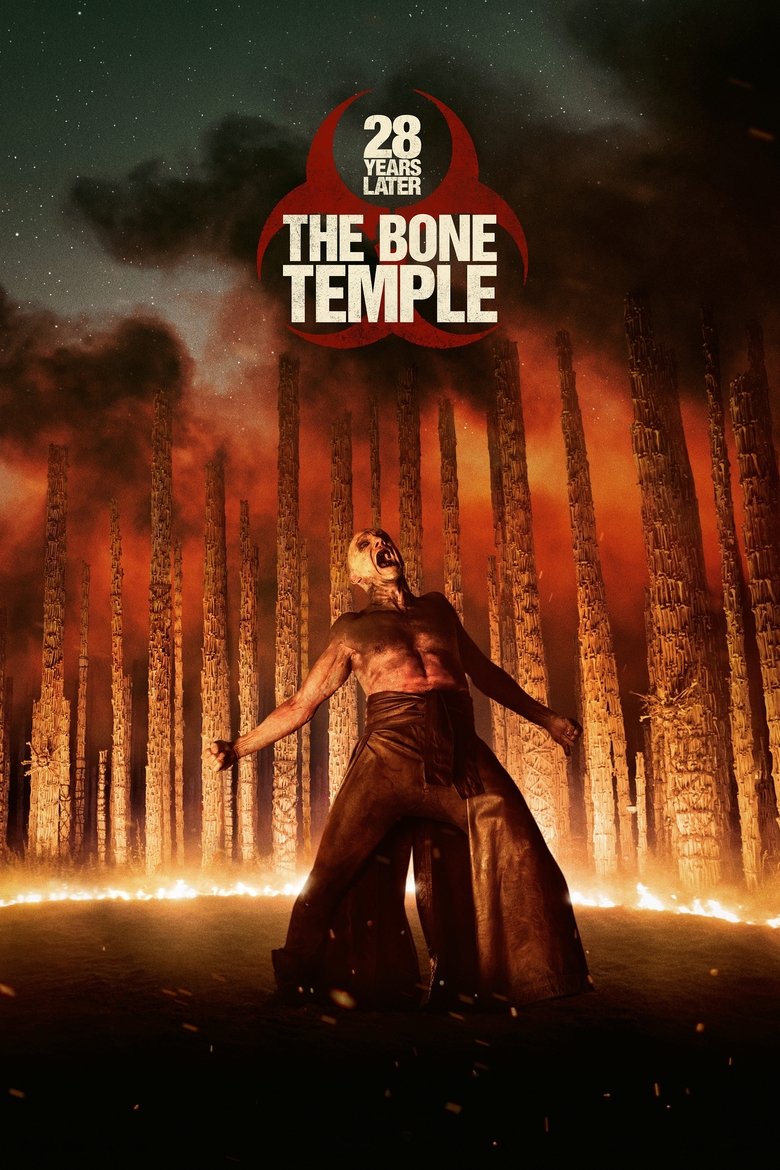
Director: Nia DaCosta Screenplay: Alex Garland Cast: Ralph Fiennes, Alfie Williams, Jack O'Connell Year: 2026
I went into this film with high expectations. Multiple outlets were flagging it as one of the year's best, and honestly, after finishing it, I found myself asking what film those recommendations were even about. It's not close. It is, plainly, my disappointment of the year. And a large part of that disappointment comes precisely from the contrast between the film I was expecting and the film the franchise decided to deliver.
In "28 Years Later: The Bone Temple" we follow two parallel lines. One tracks Dr. Kelson (Ralph Fiennes), who continues working with Samson, the zombie we already saw in "28 Years Later", extracting virus theories from him. The other tracks the Jimmys, that colored-tracksuit cult that briefly appeared at the end of the previous entry, led by Sir Jimmy Crystal (Jack O'Connell), a man who calls himself the chosen son of Old Nick, meaning Satan. Spike (Alfie Williams), the protagonist of the previous film, ends up crossing paths with the Jimmys and, having no other option, integrates himself into the group, and through him we observe the cult's internal dynamic.
The first structural problem is the film's relationship with its zombies. The saga that starts with "28 Days Later" (2002) and continues with "28 Weeks Later" (2007) and "28 Years Later" (2025) has always leaned on the infected as its central threat, on that constant oppression of a world collapsed by fast, remorseless creatures. Here the zombies are almost absent, and when they do appear they feel like a universe reminder, not a real menace. The full weight of danger falls on the cult, on humans killing and torturing in the name of Old Nick, and that pivot simply doesn't work. The horror loses its temperature.
The cult also doesn't hold together from the inside. The leader isn't charismatic, and it's obvious from very early on that everything he preaches is his own invention, something the film itself never disguises. It's hard to believe these young followers commit to him with the absolute devotion the script asks us to accept. It's a dynamic that "Midsommar" (2019) or "The Sacrament" (2013) worked with far greater precision: in those films the leader is magnetic, and the viewer understands why people fall in. Not here. Sir Jimmy Crystal is transparent, his supposed visions look artificial, and the script never resolves the dissonance. One of his so-called charities involves flaying a person alive, and even then the group never manages to convey as much oppression as a single pack of infected sprinting through a valley.
Dr. Kelson's line doesn't deliver the payoff you would expect after accompanying him for so many scenes either. His arc with Samson culminates in a resolution I didn't buy and that doesn't justify the emotional weight the film tries to load onto that relationship. There is, however, a sequence near the end where Kelson appears dressed as the devil himself, staging a whole theatrical show, and it is visually the film's best scene. Fun, absurd, memorable. The problem is that it contributes absolutely nothing to the plot; it can be cut without anything changing. That's the symptom of the script: there are loose ideas but none of them connect to the overall arc.
Technically the film holds up in several moments. Ralph Fiennes's performance is what carries the entire film, and there are three or four salvageable scenes on the audiovisual side. But as an overall proposition "The Bone Temple" loses sight of what made its franchise work. Anyone who came looking for the infected horror that defined the saga, anyone expecting a natural continuation of "28 Years Later", anyone who values this franchise as one of the best traditions in contemporary post-apocalyptic horror is going to feel as disappointed as I did. Viewers open to a radical tonal shift, to cult horror in a post-viral universe, might find something to rescue. I found it a considerable drop in quality.
Rating: 4/10
Ending Explained (Spoilers ahead)
The two paths of the film, Dr. Kelson's and the Jimmys' cult, end up crossing near the end. When Spike encounters the Jimmys and is forced to integrate, Sir Jimmy Crystal uses him as a piece in his farce, and that's when Kelson shows up posing as Satan. The scene is staged as a theatrical spectacle, with Kelson entering in costume in the middle of the cult's ritual and speaking through the "chosen son" as if he himself were Old Nick. Kelson, already inside the ritual, recognizes Spike among the Jimmys and decides not to keep playing Crystal's game. That break costs him his life: Crystal kills Kelson on the spot, and Spike responds by killing Crystal. The remaining Jimmys, with no leader, end up turning on each other until only Spike and Jimmy Ink (Erin Kellyman) survive, and the two of them leave the ritual together.
The resolution of Dr. Kelson's arc with Samson lands in parallel. Kelson has been using morphine and other therapies to calm the zombie's aggression while trying to reach whatever was still left of him inside, and in the last act the film makes clear that the work paid off: Kelson manages to connect with Samson's memories and residual consciousness through those treatments. The problem isn't that the result is implausible within the universe, it's that the film confirms it with too much clarity. It would have carried more weight had that connection been left open to interpretation, as a partial, uncertain achievement rather than a closed answer.
Spike and Jimmy Ink end up as the only survivors of the Jimmys, carrying what they witnessed and what Spike learned from Kelson during the film. The film leaves them in a position of narrative continuity for a third entry, something the structure anticipates and that "The Bone Temple" confirms with its rhythm. It's a closure that functions more as a bridge than as a conclusion, and the problem is that the bridge holds little weight of its own: the film watches like an interlude, like an obligated chapter before the real resolution, and that transitional quality is felt in every scene.
No comments:
Post a Comment