
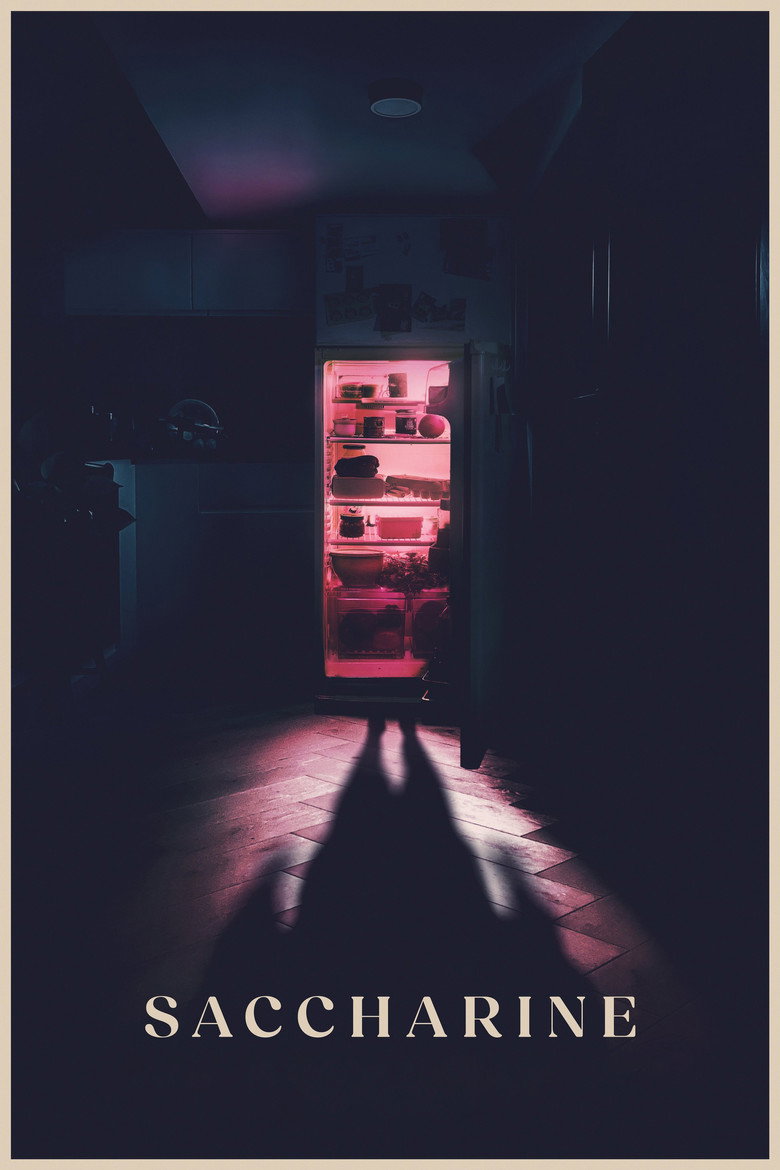
Director: Natalie Erika James Screenplay: Natalie Erika James Cast: Midori Francis, Danielle Macdonald, Madeleine Madden, Robert Taylor, Showko Showfukutei, Octavia Barron-Martin Year: 2026
When I heard the premise I thought it was absurd. Losing weight by consuming human ashes sounds like a joke, and my first reaction was to ask who on earth would do that. Then I started thinking about everything people have done to lose weight across history, the sheer number of drugs and systems and regimens that promised results without delivering them, and the conversation GLP-1s have opened in recent years precisely because they're the first that genuinely work. And the answer to my own question changed. There are absolutely people who would eat human ashes if the result were guaranteed. That's what Natalie Erika James understood before I did, and it's what makes "Saccharine" work.
In "Saccharine" we follow Hana (Midori Francis), a medical student with self-esteem problems. At a bar she runs into a woman she used to study with, someone who had been heavy and is now unrecognisably thin, and who tells her she managed it with pills. She hands over two so Hana can see for herself. Hana has scientific training, so she does what anyone with lab access would do: she analyses one to find out what it's made of. The answer is human ashes. And from that point the film stops being about a pill and starts being about what Hana is willing to do with that information.
The sub-genre is beauty-standard body horror, which has become one of the genre's most fertile territories in recent years. The obvious comparisons are "The Substance" (2024), the film that has worked this theme hardest, and "The Ugly Stepsister" (2025), which also goes to the extremes people reach to satisfy an aesthetic expectation. "Saccharine" shares their underlying logic: the body as a project to be corrected at any cost. What it adds is the scientific element and a protagonist who understands exactly what she's doing, which is considerably more uncomfortable than ignorance. Natalie Erika James comes from "Relic" (2020), where the horror also came out of the body and out of what a family refuses to look at directly, and she follows that same line here with a different object of study.
The screenplay's best move is a calibration decision: Hana, at the start, is not an obese woman. She's slightly heavy, nothing serious, nothing that constitutes a health problem. And it's still enough to destroy her self-esteem, because what's measuring her isn't a doctor but a social standard. Had the film opened with a protagonist in genuine clinical difficulty, the story would be about health. Opening where it does, it's about what society decided a woman should look like, and that makes everything after it far sharper.
The other layer the film builds well is food as an escape mechanism. Hana uses food to process everything: stress, anxiety, whatever she can't resolve. And what she can't resolve is at home. Her father is an obese man who has become entirely sedentary, who won't leave the house, and Hana watches that destroy her parents' marriage, her mother making plans for a life her husband no longer joins. Hana understands obesity as a problem reaching well beyond weight, she has it in front of her every day, and she keeps eating the same way. That contradiction is the character's real engine.
Where the film falters is in two specific places, both of them screenplay problems. The first is a couple of performances that don't quite convince; the cast is good overall, but there are moments that feel tonally off. The second is more irritating: the woman who hands over the pills appears out of nowhere, conveniently carrying the product and conveniently willing to share it, and turns up again later in a way that doesn't flow either. You can see she's there to move the plot, and in a film otherwise built with care, that seam shows.
The rest is very good. It had me from the first minute, the suspense is well sustained, the script flows, and the visual effects deliver. Robert Taylor ("Blood Vessel") brings solidity to the family material. And one detail I appreciated: Hana's sexuality is treated as unremarkable, never underlined or turned into a subject, exactly the way a heterosexual romance would be handled in any other film.
Anyone who enjoyed "The Substance" and wants the same question worked from a more intimate, less scandalous angle will find an excellent film here. Anyone who needs a screenplay without visible seams will trip on the two this one has. It captivated me from the opening and strikes me as one of the year's most interesting films, with an ending that took me by surprise and is exactly the one it deserved.
Rating: 8/10
Ending Explained (Spoilers ahead)
After identifying that the pills are human ashes, Hana makes the decision that defines the film: she starts stealing parts of the cadavers used in her medical classes, incinerating them, and consuming the ashes herself. And it works. She loses a great deal of weight, fast.
The price arrives immediately. It's as though the spirit of the person those ashes belonged to attaches itself to her, and the film chooses carefully whose they are: someone who had been obese and who died of cancer. That spirit pushes her to eat. At first it doesn't seem like a problem, because as long as Hana keeps taking the ashes she can eat whatever she wants without gaining weight, and that's the trap. The entity doesn't punish her: it removes the only consequence that had been restraining her. The hunger grows, and grows with less anxiety and more force each time.
Hana had also started a relationship with a trainer. When things spiral out of control she disappears to handle her problem alone, and later comes back to apologise. The romance seems to restart. And then Hana eats her. Literally. The film had been showing a particular painting throughout the runtime, and the state the trainer's body is left in draws a direct parallel with that image; it's a visual closing prepared long in advance.
What matters is where the blame sits, and the film is smarter about that than it first appears. The entity isn't the problem. The entity exacerbated the problem and forced Hana to see it, but the problem was already there: eating uncontrollably to avoid facing what was happening to her. Hana went looking for a quick fix to the symptom, the weight, and never touched the root, which was why she ate that way. She chose the pill instead of the question.
That's why the ending is the one the film deserved. It isn't supernatural punishment, it's the logical consequence of letting something grow unattended until the consequences turn fatal. The entity, in the end, isn't entirely to blame.
No comments:
Post a Comment