
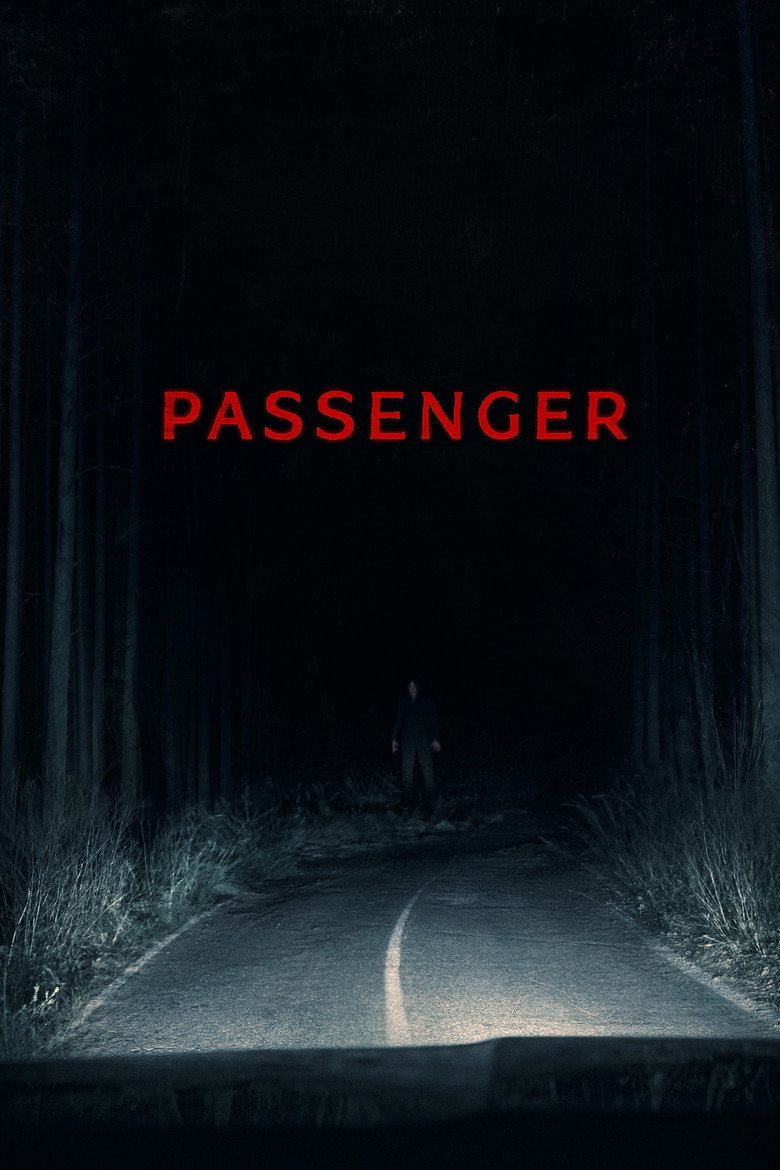
Director: André Øvredal Screenplay: T. W. Burgess, Zachary Donohue Cast: Jacob Scipio, Lou Llobell, Melissa Leo, Joseph Lopez, Miles Fowler, Alan Trong Year: 2026
Some premises collapse before they start, and "Passenger" collapsed there for me. The idea is that an entity attaches itself to people travelling the highway who make the mistake of stopping, usually at night. Written out it already sounds fragile, and the film never does the work of convincing you otherwise. That's the underlying problem: everything that follows depends on accepting that rule as unsettling, and if you don't accept it, there isn't much left.
In "Passenger" we follow Maddie (Lou Llobell) and Tyler (Jacob Scipio), a couple who decide to leave it all behind, walk away from their everyday life in New York and move into a camper van to live on the road while crossing the United States. The adventure doesn't last. Along the way they come across a man who has just been in a traffic accident, they stop to help him, and that gesture is the mistake. From there the film is the two of them trying to work out what attached to them and how to get it off.
The sub-genre is road-demon horror, and it's territory that has produced good work when someone takes the geography seriously: the highway as the place where nobody hears you, where stopping means exposing yourself. "Passenger" has the map and doesn't use it. The structure is entirely linear, you call each move well in advance, and the horror rests almost completely on jumpscares. Credit where it's due: the jumpscares are well made. They're well placed and they land. The trouble is that they're the only thing generating tension, and when a film depends on a single device, that device runs out.
The script doesn't help the characters, and the performances don't rescue them. Neither Maddie nor Tyler ever quite matters, and the lead work sits somewhere between passable and weak: some stretches hold, others land flat, without the conviction a story like this needs before you'll fear for anyone. You end up watching them solve a problem without having invested in whether they solve it.
The most frustrating part is that the ideas are there. Scenes start with real potential, with an image or a situation that promises something, and every one of them drowns in horror clichés that switch them off before they arrive anywhere. The creature design falls into the same category: visually it has interesting elements, and at the same time you can see how much it borrows from a catalogue of creatures we've already met. It contributes little to an area the genre has been building for decades.
André Øvredal, who directed "Scary Stories to Tell in the Dark" (2019), knows how to stage a scene and it shows in the isolated moments that work. But the film has no soul, and no amount of technical competence compensates for that. It resembles "Vivarium" (2019) in shape more than in substance: a couple builds a plan for a life and gets trapped inside it, except there the trap was the whole idea and here it's barely the starting point.
Anyone needing little more than well-timed scares will have an acceptable time. Anyone after a horror film with something to say, or at least a premise that can hold the weight placed on it, will find exactly what I found: a bland film, in its plot and in its characters. I finished it without much more to say about it, and honestly I think that's the worst sign a horror film can give.
Rating: 4/10
Ending Explained (Spoilers ahead)
The ending is as generic as the rest, and it arrives via the oldest shortcut there is.
Maddie and Tyler end up at a camp of people living in trailers, and there they meet a woman (Melissa Leo) who turns out to know absolutely everything about the entity: what it is, how it works, and what has to be done to end it. She's the character who shows up to explain the film, and she's contrived even by the standards of the sub-genre. Information the couple had been unable to obtain by any means up to that point gets delivered whole, in one sitting, because the script needs to reach its third act.
What she tells them is that the only way to defeat the passenger is to go to a church of Saint Christopher, the patron saint of travellers, and she points them roughly toward it. The thematic connection works on paper: an entity that hunts people in transit, a saint who protects those who travel. It's probably the best idea the film has, and it arrives too late and too explained to pay off.
At the church the demon presents itself and confronts them. Maddie and Tyler manage to trick it and run it through with a spear that forms part of the saint's statue, and the creature disintegrates.
The closing suggests the couple gives up the idea of living on the road and settles for somewhere stable. There's no turn, no ambiguity, nothing to interpret: the film completes the paperwork and leaves. It's an ending that gets to the point, consistent with the film, and every bit as bland.
No comments:
Post a Comment