
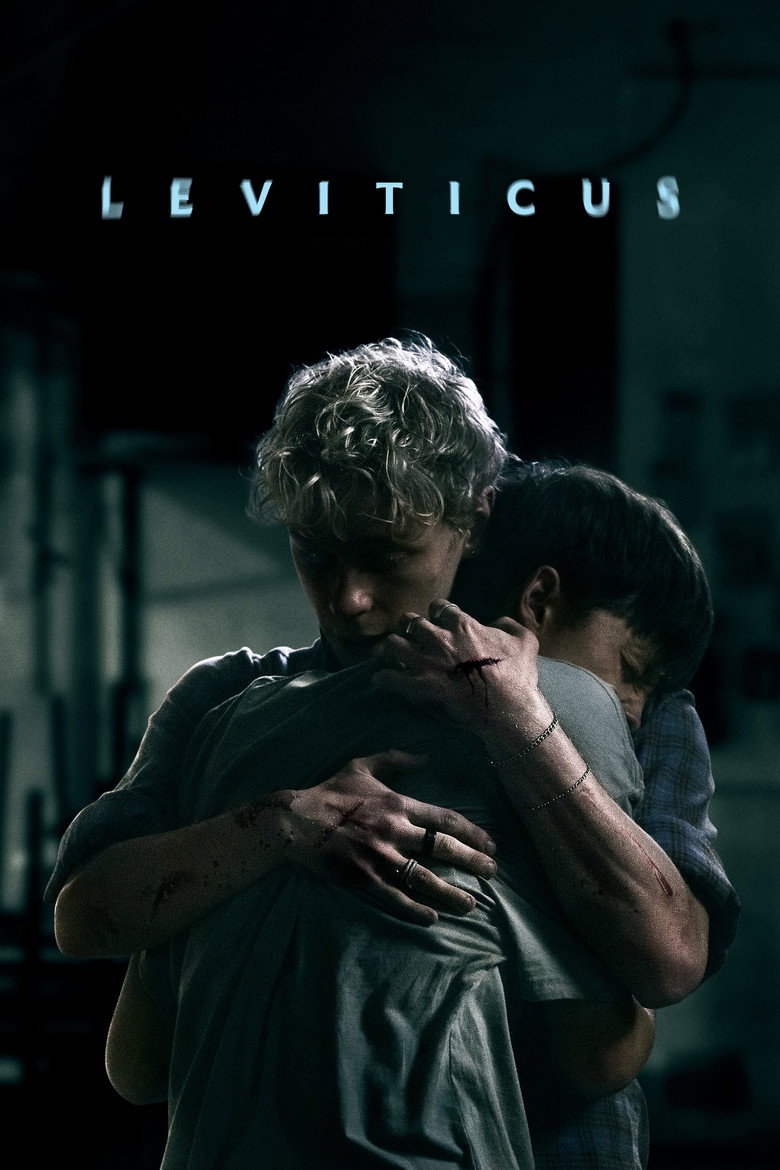
Director: Adrian Chiarella Screenplay: Adrian Chiarella Cast: Joe Bird, Stacy Clausen, Mia Wasikowska, Nicholas Hope, Tyallah Bullock, Ewen Leslie Year: 2026
There's an enormous difference between a film that treats homosexuality as a threat and a film that portrays a world which treats it that way, and "Leviticus" understands that difference better than almost any recent religious horror. The premise rests on the idea that being gay is dangerous, but that idea is never the film's: it's the town's. Adrian Chiarella puts the camera on the side of two boys who are victims of a community that doesn't understand them and has decided that what they are is wrong. That distinction sounds obvious written down, and it's exactly where this sub-genre usually fails.
In "Leviticus" we follow Naim (Joe Bird), a gay teenager who moves with his family to a small town. There he meets Ryan (Stacy Clausen), and what starts as a friendship escalates into a relationship the two of them have to keep secret. The town is deeply Christian and anchored to its religion in a way that leaves nothing to negotiate: homosexuality isn't tolerated with discomfort, it's considered outright wrong. The entire first stretch of the film runs on that pressure, on what it costs to sustain a relationship the place you live has decided to treat as a defect.
The sub-genre is closed-town religious horror, and the comparison that will follow this film around is "It Follows" (2014), because there's also a relentless entity that can't be reasoned with. The parallels exist and they're visible, but the two films are talking about different things: in "It Follows" the threat travels through sexual contact and works as a metaphor for transmission, while here the mechanism is activated by the community, not by desire. What pursues these boys isn't the consequence of sleeping with someone; it's the consequence of someone deciding to cure them. That shift in origin changes the thesis completely, and it's what keeps "Leviticus" from being an echo of the film it'll be measured against.
The film's central idea, and its best decision, is the shape the entity chooses. It doesn't appear as a monster or an anonymous figure: it appears wearing the face of the person each of them loves most. Naim sees it as Ryan and Ryan sees it as Naim, and the point isn't to kill them quickly but to separate them, to make each one afraid of the other. It's a cruel and very well-considered idea, because it turns affection into the vehicle of the terror and gives the threat a purpose identical to what the town wanted all along. The effects are sparse, but when they appear they're credible and they serve that idea.
And there's the reading that holds the whole film together: the entity is society. It doesn't need to attack to do damage, because its real power is surveillance. It's always there, watching, waiting, reminding them there is no moment when they get to lower their guard. It's exactly what the town does to them: it doesn't hit them every day, it watches them every day. The permanent threat that something will happen to them for being who they are wears them down more than any specific act of violence, and Chiarella turns that feeling into a figure walking behind them in no hurry at all.
The performances are solid without dazzling, and the cast delivers what the screenplay asks, with Mia Wasikowska adding weight in Naim's family life. But the real casting and directing win is elsewhere: the film's three gay characters are presented as ordinary young men. Chiarella doesn't push them toward caricature or the effeminate stereotype this kind of cinema still uses as shorthand. They're simply young men attracted to other young men, and that ordinariness makes the judgment the town imposes far more uncomfortable, and far more effective.
Where the film comes up short is the horror. I expected more, and it turns timid exactly where it could press: there are stretches where the threat feels administered with too much caution, and some moments where the pace dips, though that last part is minimal and the rest of the runtime moves well. When it does decide to bring the horror it brings it properly, and that's the frustration: you leave sensing there was more film available in that register.
Viewers who value horror that uses the genre to talk about something specific, and anyone who wants the best recent variation on the pursuing entity, will find one of the year's most interesting films here. Anyone after intense, sustained horror will notice the restraint. I thought it was a film with an excellent underlying idea, executed with more intelligence than ferocity, and with an ending that gives it a weight I wasn't expecting.
Rating: 8/10
Ending Explained (Spoilers ahead)
The mechanism that sets everything off isn't supernatural, it's human. Naim discovers that Ryan is also seeing another boy in town, Hunter, and reacts the way a hurt teenager reacts: he tells. He tells Hunter's parents, and Hunter's father turns out to be the church preacher. The consequence is immediate: the boys are taken before a priest who performs a kind of exorcism on them, a ceremony meant to drive the homosexuality out.
What the ceremony achieves is the opposite of its intent. It takes nothing from them; it opens a door. From that point the entity begins pursuing them, and for a while it gets what it wants: the two begin to fear each other, and that distrust does more damage than any attack.
They look for a way out across much of the film and never find one. What Naim and Ryan end up doing is accepting that they'll keep being pursued, and deciding to carry it together. They also decide to leave the town, because they understand there's no livable version of their lives in that place.
The final shot is what gives all of it force. The two of them are on a bus out of town. Naim looks through the window and sees Ryan standing in a field, watching him, and we know it's the entity because the real Ryan is sitting beside him. Naim looks at it, and then simply looks away.
That gesture is the film's thesis, and it's worth being precise, because it isn't a victory and it isn't a surrender. Naim doesn't beat the entity and he doesn't escape it: he accepts that it will always be there, the same way he accepts that the society it stands for isn't going to change, and he decides not to spend his life fighting something that can't be beaten. But he also doesn't hand over the one thing they were asking for, which was to stop being who he is. He keeps his identity and he keeps the pursuit, knowing exactly what that will cost him. Looking away isn't denial: it's the decision to live with the threat in plain sight, in full awareness of the price. That is what makes it more than a ghost story.
No comments:
Post a Comment