
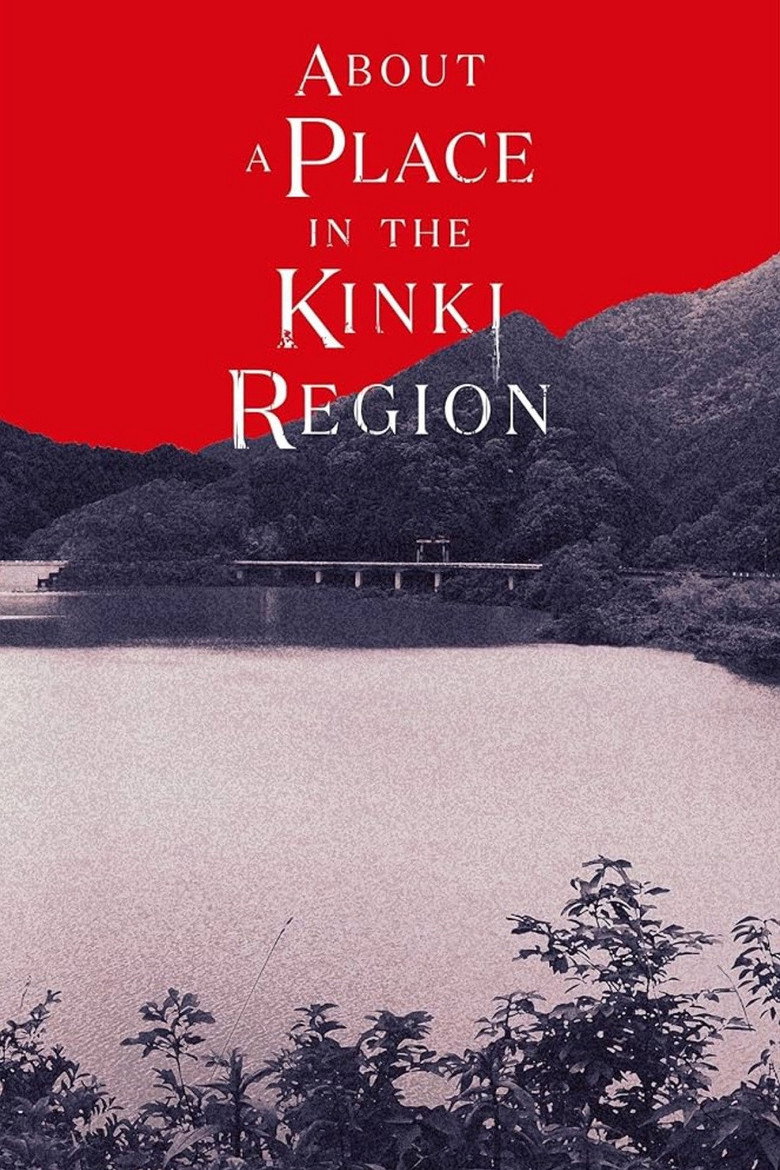
Director: Koji Shiraishi Screenplay: Koji Shiraishi and Tetsuya Oishi Cast: Miho Kanno, Eiji Akaso, Atom Shukugawa, Kyo Sato, Nose Rin Year: 2026
There's a Japanese strain that has run on the same promise for over two decades: someone collects other people's tapes, clippings and recordings, sits down to go through them, and the viewer works out alongside them that all of it points at the same thing. Koji Shiraishi practically lives there. Since the early 2000s he has been directing cursed-video and incident-investigation pieces, and "About a Place in the Kinki Region", which also circulates as "Kinki" and as "The Curse of Kinki", is another entry in that tradition. The formula isn't the problem. The problem is that this time the archive outweighs the film.
In "About a Place in the Kinki Region" we follow Seno Chihiro (Miho Kanno), brought in to continue the work of an editor at an occult magazine who vanished mid-investigation. With her is Ozawa Yusei (Eiji Akaso), a younger colleague. Neither of them knows much about what the man had been doing, so they inherit his entire archive, a mass of recordings, newspaper clippings and several USB drives, split it between them and start watching. The only thing clear early on is that all of it points to a series of events in Japan's Kinki region, and that the people who appear in those videos end up dead or missing.
The structure is the most interesting thing the film has, and it deserves the credit. The script feeds you information in pieces and puts you exactly where the investigators are: you're connecting the same dots at the same time, from the same material, with no more context than they have. I also liked the mix of found footage with conventional filmmaking, which Shiraishi alternates fluidly and which gives the whole thing a texture pure handheld can't reach. There are genuinely striking images and a couple of deaths that land hard.
The problem is how rarely that happens, and how much of the rest is accumulation. It dispenses far more information than it later intends to use, opens threads it never develops and leaves loose ends it never gathers, and that excess turns the investigation, which should be the engine, into paperwork. The build is long and it's boring. I struggled to get through the first stretch and fell asleep more than once, which is an uncomfortable thing to write in a review but it's the honest one. It lacks tension and it lacks pace. The supernatural elements are there, but they're deployed with a timidity that doesn't suit a 103-minute film built on mystery: some work well, some don't work at all, and collectively they're too soft to hold the fear.
The most frustrating thing is what happens with the twist. It surfaces fairly early, and while it isn't conclusive at that point, it's enough to leave you fixed on whether that's really what's going on. From there your attention shifts: you stop following what the investigation turns up, which is what the film wants from you, and start auditing your own suspicion instead. That drains the tension out of the entire middle. Then there's the worse problem: when the ending arrives and confirms what was happening, you realise a fair amount of the build doesn't fit that explanation. The close doesn't crown the work before it, it dismantles it, and leaves the sense of a script less tuned than it seemed while it was moving.
Something has to be said for the creature, because in design terms it's the best thing here. It looks very good, it's creative, and it doesn't resemble what you've already seen in this kind of cinema. Which is exactly why it stings that it turns up near the very end and gets used so little. The performances aren't bad, but they never quite convinced me, and in a film resting on two people reviewing files, that gets noticed.
Fans of Japanese found footage and of incident-investigation cinema will find a structure they know here and a few moments worth having. Anyone who needs a mystery to hold tension through its first two thirds will be bored, and anyone who demands that an ending coherently close what the build opened will leave irritated. I wouldn't recommend it, not for poor craft but for how heavy it becomes. It had potential on several fronts and it has its good scenes, but they don't cover the rest.
Rating: 4/10
Ending Explained (Spoilers ahead)
Chihiro and Ozawa manage to locate the missing editor, far from his home and his workplace. They find him badly deteriorated, living in near-inhuman conditions alongside his wife, who is in the same state and behaves more like an animal than a person. He has one eye covered and reacts violently at the sight of Chihiro, telling her she deceived him once already and that what is happening to him is her fault. Ozawa doesn't understand the accusation. Before they can get anything more out of him, the man hands them another USB drive, and then he and his wife take their own lives.
The material on that drive shows a group of women operating almost as a cult, performing a ritual in honour of loved ones they have lost. Ozawa recognises one of them: it's Chihiro. Confronted, she admits she was in the group but insists she left after a week and has nothing to do with it.
The recordings also show a stone the women venerate, and Chihiro herself identifies that stone as the source of all of it, and destroying it as the only way to stop the chain of deaths and disappearances. Following the investigation they reach a lake where they understand it to be.
That's where it's revealed that Chihiro never left. She is still part of the group, she has control over the stone, and she brought Ozawa to that place to hand him over as an offering. It's also the moment the creature appears, and it takes him. What Chihiro wants in exchange is the return of her baby, dead days after being born.
That motive is the strongest part of the explanation, because it makes Chihiro one more of the ritual's women rather than a villain. The problem is that the reveal forces a rereading of the build, and on rereading too many pieces stop making sense: an investigator who controls the object she's investigating needed none of what the film put us through.
No comments:
Post a Comment