
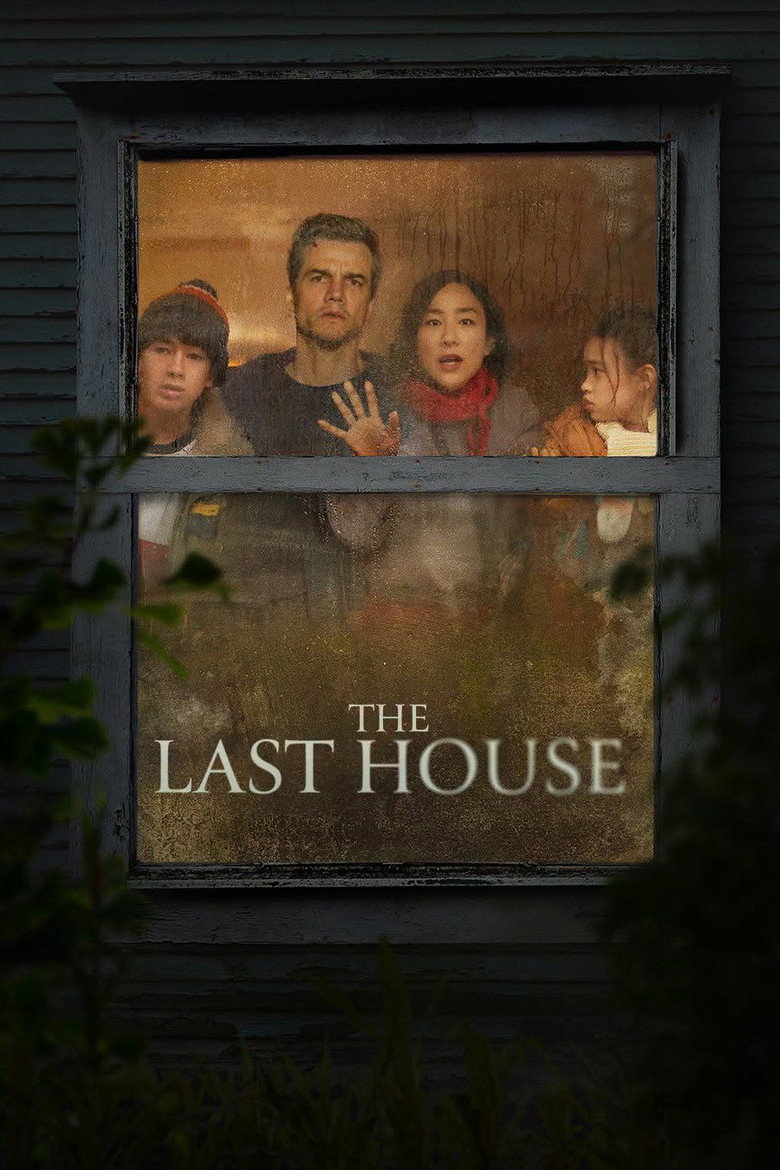
Director: Louis Leterrier Screenplay: Matthew Robinson Cast: Greta Lee, Wagner Moura, Arden Cho, Riley Chung, Noah Sosnowski, Emma Ho Year: 2026
Netflix genre films carry a penalty: the automatic suspicion that anything coming out of the platform is disposable. "The Last House" is paying that tax, and a good share of the negative reviews it has piled up have more to do with the logo that opens the film than with what the film actually does. I went in with no idea what it was about, convinced it was something else entirely, and it had me from the first minute. One thing to establish up front: this is not pure horror. It is science fiction and suspense with horror elements, and anyone arriving expecting otherwise will leave annoyed for reasons that are not the film's fault.
In "The Last House" we follow a family of four, Ann (Greta Lee), Jason (Wagner Moura) and their two children, on a rainy day that starts like any other. The water falls, and suddenly every house in the neighborhood is sealed shut: the doors will not open, nobody can get out, and there is no explanation in sight. Phones lose signal, the internet drops, and the only communication left between neighbors is improvised signs in the windows. The first thing the family manages to work out is not what is happening, but that there is a pattern, and that the pattern has to do with the water falling outside.
The sub-genre is domestic siege crossed with apocalyptic science fiction, and the film plays by those rules: an unexplained phenomenon, a survival rule the characters have to deduce by observation, and a sealed space with no way out. The obvious comparison is "A Quiet Place" (2018), which also builds its tension on a rule the audience learns alongside the protagonists, and "Bird Box" (2018), Netflix's earlier run at this same territory, which "The Last House" clears comfortably. But the reference that stuck with me was Spielberg's "War of the Worlds" (2005): there are nods there, in the scale of a threat viewed from one family's eye level, and in the refusal to ever hand the audience the wide shot that would clarify everything. What "The Last House" pulls off that its predecessors never attempted is turning something as ordinary and as essential as rain into a permanent prison.
The sequence that best shows what Leterrier understood about this material is the one with the signs. With no phones and no internet, the neighbors are reduced to writing messages by hand and holding them against the glass, and the film shoots the exchange from inside every time, through the window, with the rain distorting whatever can be made out on the other side. It is pure exposition, the kind of scene that in other hands would be a chore, and here it works as the moment the film sets its scale: there are other people locked in, nobody knows more than anybody else, and information arrives in fragments that have to be interpreted. The sound design carries the other half of the work, with water as a constant layer the ear stops registering until the film decides to raise it. Leterrier comes from action filmmaking, and what he lends this material is not adrenaline but spatial clarity: you always know where every character is inside that house, and that matters a great deal later on.
The structure is the most ambitious thing in Matthew Robinson's screenplay. The film is not content with days: it moves to weeks, then months, then years, and the confinement stops being an emergency and becomes a way of life. Ann and Jason improvise ways of feeding themselves inside the house, the family draws closer while the food holds and fractures when it stops holding, and the son hits adolescence reading that survival not as an achievement but as captivity. That generational shift in perspective is the film's strongest dramatic engine. The cast handles the erosion well, with Greta Lee ("Past Lives") and Wagner Moura ("Narcos", "Civil War") playing the decline with restraint, and with the casting device of using different actors for the children at different ages, which solves the time jump without digital tricks.
There is a reading here about isolation and what it does to the human mind that the film works without underlining it, and the parallels to the COVID-19 lockdown are there for anyone who wants them. Where "The Last House" fails is on two concrete fronts. The first is credibility: it is hard to accept that this family held five years of that dynamic without breaking further than they break. The second is the ending, which for all the tension the film accumulates across 110 minutes lands below the rest of it. It is not a terrible ending, and it ruins nothing that came before; it simply could have been considerably better, and you feel it.
Viewers looking for creature filmmaking with good pacing, solid visual effects and a monster design that steps outside the expected will find a better surprise here than its reception suggests. Fans of explicit horror, gore or sustained scares will not find much appeal, because this is suspense and science fiction before it is horror. I enjoyed it start to finish, and I suspect that in a few years it gets reappraised as one of the casualties of the reflexive bias against Netflix originals.
Rating: 7/10
Ending Explained (Spoilers ahead)
For much of the runtime the film leaves open the possibility that this is an alien invasion. It is not, or at least not entirely: the creatures sealing the houses appear to be inhabitants of this planet, ocean creatures with control over the rain, using it as a mechanism to immobilize humans and stop them from moving anywhere. The film never fully explains it, and that ambiguity is deliberate.
When we finally see them, the design is the best thing in the film. It is a version of the cosmic creature underpinning much of H.P. Lovecraft's work, visually related to Cthulhu and to Leviathan, but corrected for scale: instead of the gigantic, overwhelming monster those names usually summon, this is a creature proportioned to the planet's real fauna, anchored to the earth and the ocean. It is a smart call from Leterrier and Robinson, because it makes credible a monster that in its canonical form always reads as abstract.
The third act starts when one creature gets into the house and destroys the crop the family had built over years, salting the soil and the drinking water. With their sustenance gone and the son in open revolt against the confinement, the family decides to force their way out. They know the creatures are the ones who open and close the access points, so they plan to lure one inside. They succeed, and the creature floods the house completely: the home becomes a fish tank reproducing ocean conditions, a tactical inversion in which the humans are suddenly the ones out of their element. There is a short confrontation the family had prepared for, and they capture it.
And then the film makes its most interesting choice: instead of killing it, they show it mercy and let it go. The creature answers the gesture by opening the house and signaling the rest of its kind to withdraw from the area. The family walks out into an unrecognizable world, with an enormous death toll behind them and nature having reclaimed the spaces that had been developed. The closing leaves signs that they are not the only survivors, and the reading it proposes is one of a new beginning for humanity, this time on a planet that is no longer theirs by default.
No comments:
Post a Comment