
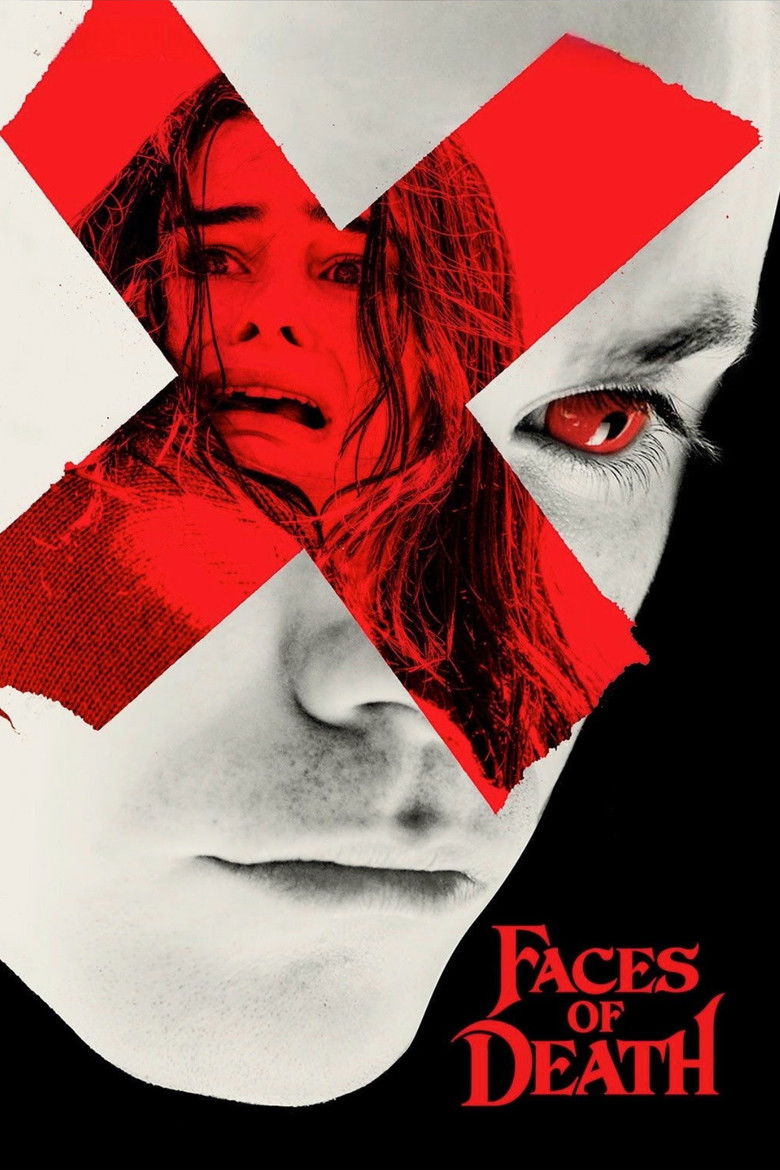
Director: Daniel Goldhaber Screenplay: Daniel Goldhaber and Isa Mazzei Cast: Barbie Ferreira, Dacre Montgomery, Josie Totah, Aaron Holliday, Jermaine Fowler, Charli xcx Year: 2026
Remaking "Faces of Death" was a bad idea from the outset. The 1978 original was a scandal phenomenon built on a commercial lie: it promised real deaths, most were staged, and the footage that was genuine came from found material rather than anything the production caused. A literal remake of that today would have nowhere to go. What Daniel Goldhaber and Isa Mazzei do instead is the smartest available move: not remake it, but use it as a starting point and carry its central question into a present where death footage no longer circulates through video stores but through everybody's feed.
In "Faces of Death" we follow Margot (Barbie Ferreira), a content moderator for a social media company whose job is watching the worst thing people upload so nobody else has to. Among that material, videos start appearing that she can't classify. They're made in a way that suggests staging, and that's the comfortable reading, but something in them tells Margot the deaths she's watching aren't faked. The doubt becomes obsession, and the obsession pushes her to investigate who's behind the material on her own, far outside anything her job asks of her.
The sub-genre here is found-footage horror crossed with the investigative thriller, and the closest reference in this catalog is "Sinister" (2012), which also opens with someone watching filmed deaths and ends with them destroyed by the need to understand them. The difference is where each locates the horror. In "Sinister" the footage is a cursed object; here the footage is a product, with an audience, with metrics, and with someone calculating how to make it circulate. Goldhaber and Mazzei had already worked this territory in "Cam" (2018), where a woman's digital identity slipped out of her control, and "Faces of Death" is the darker version of that same worry: what happens when the platform doesn't merely distort one person's life but becomes the reason to end others.
The best thing the film has is its villain. Dacre Montgomery builds a man who is brilliant, manipulative and genuinely hard to anticipate, operating not from chaos but from a plan that understands exactly how attention works online. He identifies who is hunting him before anyone else does, researches her, and from that point doesn't pursue her so much as play with her. The stretch where he begins shaping how the authorities perceive Margot is where the film proves its antagonist thinks better than its protagonist, and that asymmetry is what holds the tension. In another era this character would have become an iconic villain. The problem is that we've reached a point in the genre where this archetype, the methodical killer who treats his violence as work, has been built many times, and however well executed it is here, it never quite stands above its predecessors.
Structurally the film splits in two, and both halves work. The first is near-forensic investigation: tracing metadata, comparing framing, understanding how a video gets manufactured and distributed. The second abandons that register and becomes practically a slasher. It's a risky gear change that in weaker hands would have snapped the film in half, and here it's controlled enough to feel like a consequence rather than a free genre pivot. What joins the halves is the 1978 film's own question, updated: what does watching death through a screen do to a person, and what does it do to another to decide it's worth producing.
Where the film gives ground is pacing, which slackens in stretches, and a handful of screenplay decisions that don't quite square with the logic the characters had been showing. None of it is severe or derails the whole, but you notice. And there's a harder problem that isn't about execution but about context: the characters are well built without being memorable, and at a moment when the genre releases this much, being well made isn't always enough to be remembered.
Viewers who value horror that thinks about the internet without lecturing, and anyone who followed the line from "Host" to "Dashcam", will find something considerably more ambitious than either here. Anyone chasing the raw provocation of the 1978 original will hit something colder and more structured than they expected. I thought it was a very good film and one of the most original ideas of the year: take an infamous title and, instead of repeating it, ask what it would mean now. I suspect it will be ignored by much of the audience it's speaking to, and that's a shame.
Rating: 8/10
Ending Explained (Spoilers ahead)
Margot's obsession isn't professional, it's personal, and the film holds that explanation back until well into the plot. As a teenager she filmed a video for social media with her sister: a dance on train tracks, the idea being to run clear just before the train arrived. Her sister slipped getting off and the train killed her. The video had been Margot's idea. Everything comes from there: the trauma, the guilt, and the decision to work in content moderation so that kind of challenge stops circulating and doesn't take anyone else.
The man behind the videos is Arthur (Dacre Montgomery), obsessed with the 1978 original to the point of recreating its deaths one by one. What he's after isn't only reproducing them but uploading them and having them spread, which is why he escalates toward public-facing victims, a television reporter and an influencer, calculating that recognisable faces would make the material travel faster and further.
Margot reaches him by the clumsiest route available, posting fragments to a Reddit-style forum so other users can help identify the source. Then she gets something firmer: she accesses the raw files at the company where she works, which retain information about who uploaded them. But Arthur is watching those same forums, sees what she's posting, and sends her an address himself. Before she can use it he gets there first: he locates her, drugs her with fentanyl, exactly the method he used on his other victims, and takes her to the house where he films. There she discovers other people are being held, the reporter and the influencer among them.
Margot escapes and takes a hard drive containing all the raw material. The police don't believe her: the fentanyl in her system reads as recreational use, and Arthur had already seeded doubt about her. So she goes back, and goes back prepared, wearing a hidden camera and microphone. She gets the confession, the fight ends with her stabbing him repeatedly, and with Arthur dying behind her she films herself recounting what has just happened.
Then she uploads it. That's the closing move, and it's the film's best: Margot uses the exact platform that took her sister, and the same distribution mechanism Arthur had turned into method, for the opposite purpose. He wanted the world to watch strangers die; she makes the world watch him die and understand why. The cycle closes where it opened.
No comments:
Post a Comment